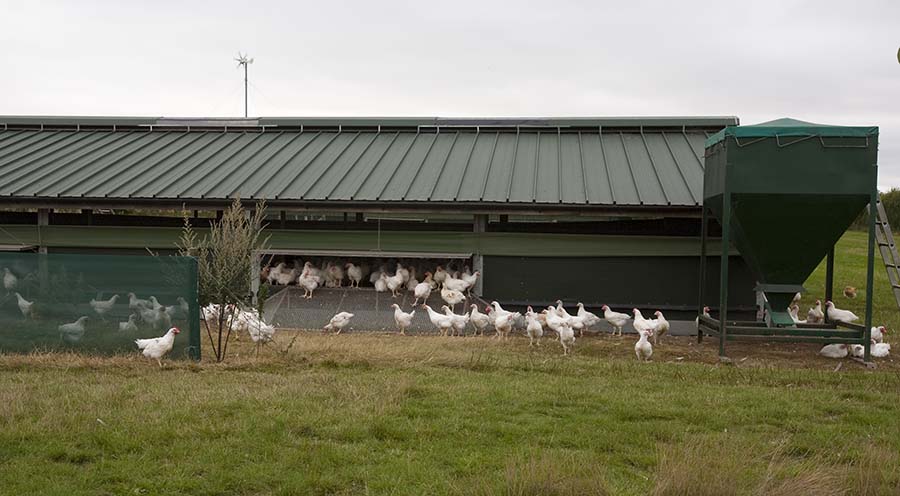
The Fallacy of “One Barn, One Temp”
Walking into an older hoop barn, you’ll often see a single hand crank at the end of the building. The farmer turns it, and both sidewalls roll up simultaneously. It’s simple, and it’s cheap, but it’s a mistake.
This setup is built on the “One Barn, One Temp” fallacy: the idea that if the thermometer in the center of the room reads 85°F, then the whole barn is 85°F, and to fix it, you need to open both walls. But this assumes your barn is essentially a static shoebox, whereas in reality it’s an aerodynamic structure in a moving fluid (the wind). The conditions on the North wall are rarely the same as those on the South wall, and treating them as if they were the same will lead to problems.
The Zoning Argument
To understand at a visceral level why you need independent control of your sidewalls (Zoning), let’s look at what the wind is actually doing to the structure.
The Windward Side
The side of the barn facing the wind is under positive pressure. The wind tries to force its way in, pounding relentlessly against the sidewalls. The problem is that if you open this side fully to bring in fresh air on a windy day, it pressurizes the barn, generating high-speed drafts that raise dust and debris and can chill livestock.
The Fix: You can usually get sufficient fresh air intake by cracking the curtain open by just 10-20%.
The Leeward Side
The side facing away from the wind is under negative pressure (suction). As the wind flows over the curved roof of the hoop structure, it speeds up, creating a vacuum on the back side (it’s the same principle that airplane wings use to create lift).
This side is your exhaust. That negative pressure actively sucks stale, hot air out of the barn.
The Benefit: You can often have this curtain open 100% to maximize exhaust, even while the other side is barely cracked.
The Solar Factor
So yes, the “One Barn, One Temp” approach falls apart in the face of wind. But does it work on those clear, calm days? Well, not quite. We always have to consider the sun.
Unless your barn is in total darkness, the heat load on your building is never uniform. In the morning, as the east wall is exposed to direct solar radiation, the air along that wall heats rapidly, while the west wall remains cool and in the shade. By late afternoon, the situation flips.
If your curtains are tied together as a single zone, you have no choice but to overheat the sunny side or overcool the shady side. You’ll never get it balanced just right because the heat source (the sun) is constantly moving.
The Wind Tunnel Disaster
Here’s where we come face to face with the problem of that single hand crank (or a single motor linked to both sides): You’re forced to compromise.
If you open both sides fully to flush out the solar heat, the windward side lets in too much turbulent air, creating a wind tunnel that strips heat from your animals and kicks up dust and debris. But if you lower both sides to 20% to minimize the draft, you trap the heat baking the barn and choke off the exhaust on the leeward side.
The Solution: Split-Zoning
Modern ventilation systems solve this conundrum by separating the barn into independent zones. By raising and lowering the two walls independently, you can treat the leeward side as a wide-open exhaust to dump hot, stale air while restricting airflow from the windward side to a trickle. You might even visualize the windward curtain as a throttle. You can precisely control the velocity of the incoming air to prevent drafts, while still keeping the back door wide open for maximum air exchange. You get the cooling you need without the turbulence you hate, but only if your hardware allows the two sides to move independently.
From Theory to Reality
The concept of split-zoning is easy, but managing it day to day is harder. Ideally, you could adjust your curtains whenever conditions change—drop the leeward side when the sun hits it, or throttle the windward side as a storm rolls in. But you can’t spend your entire day standing by a hand crank waiting for the wind to shift—you have a farm to run!
The bottom line? If you rely on manual labor, split-zoning will be nothing more than a nice theory. To make it a reality, you need to hand that responsibility over to a machine.
The Muscle: Drive Systems
This brings us to the hardware. To achieve the kind of independent, responsive control we just discussed, the hand crank has to go.
Manual vs. Motorized
For smaller hoop houses or hobby farms, a manual gear crank is cheap and reliable (and it gives you a free workout!) But for commercial livestock operations, a manual crank is a bottleneck.
While a manual gearbox can raise and lower curtains by degrees as conditions demand, the reality of farm operations means they rarely do. It’s just not wise management to designate one person to stand by the wall and make micro-adjustments to the curtains every time the wind shifts. As a result, manual barns often get stuck in “set it and forget it” mode, which completely eliminates the benefits of active zoning.
Motorized systems are the real power behind active zoning. You don’t even need a computer to manage zones effectively—you need speed. A motorized system turns that heavy, twice-daily chore into a simple reflex. With a simple flick of a switch, you can vent the entire barn in seconds during a hot afternoon lull, or button it down tight the moment you see thunderheads rolling in.
Stationary vs. Climbing Motors
Once you decide to motorize, you’ll encounter two main designs. Consider in advance how many zones you want to make, because that will often dictate which design you need.
Stationary (Window Shade) Motors
A stationary motor is mounted permanently at the end of the barn. It spins the long drive pipe, rolling the curtain up like a window shade. These are simple, but on very long barns, the torque required to spin a 300-foot pipe can be immense, causing the pipe to twist and lag at the far end.
Climbing Motors (Power Climbers)
Instead of trying to spin a long, heavy pipe from one end, the motor is mounted directly to the curtain’s drive pipe and physically climbs up a vertical guide column. Because the motor moves with the curtain, it reduces the torque load on the pipe and provides smoother operation.
Pro Tip: Zoning by Population
Climbing motors also give you the advantage of split-length control. Because power climbers don’t need to control curtains along the entire length of the barn, you can split a long sidewall into separate segments to establish independent longitudinal zones.
This is a critical advantage, for example, if you are housing younger, vulnerable animals in the south end and older, hardy animals in the north. By installing two climbers on the same wall, you can manage the sections independently—venting aggressively for the mature animals while keeping the nursery section draft-free—right next to each other.
The Safety Net: Limit Switches
In all of this, there is one piece of automation you absolutely need: a limit switch. It’s a simple mechanical device that tells the motor when to stop. Without one, a distracted operator holding a toggle can easily run the curtain right off the top track or crush the bottom hem.
While the safety feature is essential, a limit switch can also make your daily life easier. You can use it to set consistent “open” and “closed” positions. You can even set a “Winter Vent” limit that stops the curtain exactly at a 6-inch crack, so you hit the perfect airflow every time without having to stand there and eyeball it.