

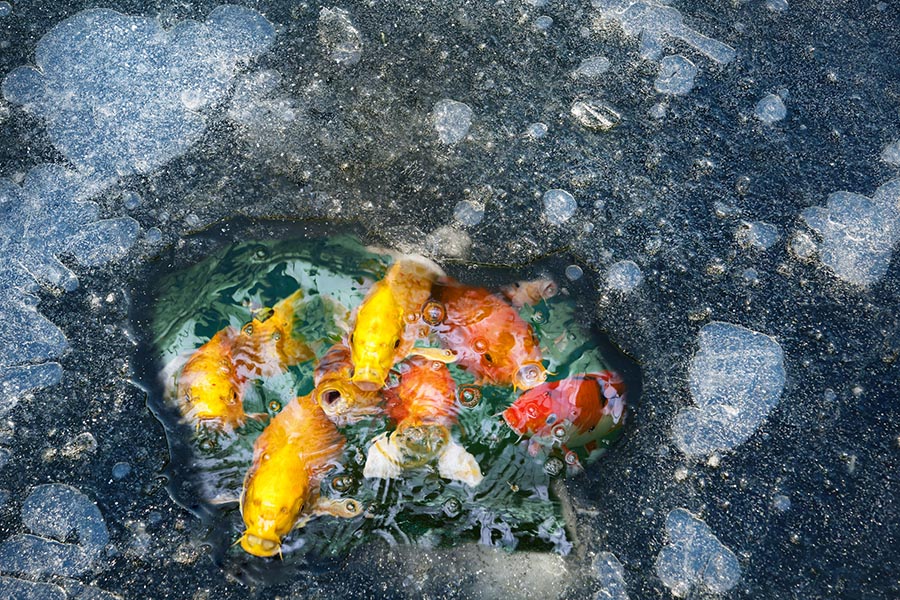
When a pond is sealed under a layer of ice, it tends to hide many of the most serious problems. The water may look clear, but that doesn’t mean all is well. In fact, there could be a virtual fish apocalypse going on that won’t become obvious until the spring thaw. In this chapter, we’ll explain how to read the subtle signs of fish health and water quality in a closed winter environment: the fragile chemistry of a winter pond, how to assess your fish from a distance, and how to troubleshoot the most common winter issues.
Winter Water Chemistry: A Stable but Fragile Balance
In many ways, the water chemistry in a sealed winter pond is more stable than at any other time of year. With no runoff, no rain, and minimal biological activity, parameters don't swing wildly from day to day. However, this stability is fragile. Because it's a closed system, any problem that does arise can escalate quickly with no natural mechanism to correct itself.
Fortunately, with a basic understanding of pond chemistry, you can interpret what you’re seeing and respond appropriately.
Ammonia and Nitrite
Ammonia and nitrite are toxic compounds produced by fish waste and the decomposition of organic debris. During the summer, the bacteria in your biological filter processes them quickly and converts them to less harmful states. In the cold of winter, however, the beneficial bacteria are dormant. This means any ammonia produced by decaying leaves and sludge at the bottom of the pond will build up, creating a toxic environment. (This is why the fall cleanup is so critical.)
pH
In a summer pond, pH naturally rises during the day as plants consume CO₂, and falls at night as fish and bacteria switch to producing CO₂. In a pond sealed under ice, photosynthesis ceases and gas exchange is extremely limited (or absent altogether). This allows the CO₂ level to slowly and steadily rise. As the CO2 dissolves in the water, it converts to carbonic acid, causing the pH to gradually drop. (Low pH = acidic water.) Now, a slow, slight drop over the course of the winter is normal. A rapid drop, however, indicates a serious CO₂ buildup, likely from too much decomposition.
KH (Carbonate Hardness)
Essentially, KH (alkalinity) is your pond's buffer against pH swings. It's what keeps the pH stable, but on its own it doesn’t make the water more alkaline. That can be difficult to visualize, so try this:
Think of KH (carbonate hardness) as an overdraft account, and pH as your day-to-day expenses. Now having a generous overdraft account (KH) on standby doesn’t mean you have extra money to spend. It’s just a safety net. When your expenses suddenly rise (an acid is introduced to the pond), your overdraft account kicks in (the KH neutralizes the acid) and keeps your finances running smoothly (the pH remains stable). That’s a good thing! But if your overdraft account gets maxed out (the KH is depleted), you’re suddenly unable to meet your obligations (the pH crashes), and your fish are left in a toxic environment (you have overdue bills).
Clearly, it's essential to ensure your pond has a healthy KH level (ideally above 100 ppm) before the winter freeze. The buffer it provides during the winter will help neutralize the acids inevitably produced by fish respiration and organic decomposition and resist the pH drop from CO₂ buildup.
So, what's the takeaway? Don't get caught up chasing "perfect" numbers with your test kit all winter. It’s better to ensure your pond's chemistry is balanced and stable before the first freeze. After that, trust your fall preparations and keep your test kit on the shelf, ready only if you spot clear signs of trouble.
Visual Health Assessment: Reading the Signs
Observing your fish in the winter can be quite a challenge when they spend their time at the bottom of a deep pond, where it’s hard to see details through distance, ice, and perhaps even a layer of snow. Fortunately, the normal, healthy behavior of deep torpor can be verified without a lot of visual detail. After all, you aren’t looking for the active, vibrant fish of summer; you are looking for peaceful rest.
Signs of a Healthy Fish in Torpor
Position
Look for fish to be resting quietly on the bottom of the pond, often in the deepest area. They may be in a loose group or solitary.
Movement
Very still for long periods. Gill movements (operculum flaps) will be slow and shallow. They may slowly and deliberately adjust their position from time to time.
Appearance
Fins are held in a relaxed or neutral position, not clamped tightly to the body. The body itself is free of any visible sores, white patches, or unusual redness.
Warning Signs: Reading the Signs of Trouble
While you won’t be able to do a regular, detailed inspection of every fish, any of the following behaviors clearly signal a problem that requires immediate attention.
Gasping at the Air Hole
This is the #1 red alert for a pond emergency. Fish congregating and gasping at the surface opening is a sign of severe oxygen depletion (anoxia) or toxic gas buildup. It is never normal behavior.
Clamped Fins
A fish that holds its fins tightly against its body is communicating stress. This is often an early indicator of poor water quality or the onset of disease.
Visible Sores or Fungus
Look for open red sores (ulcers) or white, cotton-like growths on the body or fins. A fish's immune system is weak in the cold, making them more susceptible to bacterial and fungal infections.
Erratic Swimming
While fish in torpor are mostly still, a fish that is spinning, rubbing against objects (“flashing”), or struggling to stay upright is showing signs of a serious health problem.
Pro Tip
One of the most common ways to get a visual of your fish is to peer through the ice when it’s not covered in snow. Caution: only do this during a hard freeze so you don’t find yourself joining them!) The air hole is another good place to monitor. Be careful to approach quietly so you don’t spook them. At night, try a powerful, waterproof flashlight to illuminate the depths beneath the hole. This may be the best way to catch a glimpse of a fin or the side of a fish to check its condition.
If you’re one of those cool gadget people, a submersible camera on a cord or pole is an excellent tool. It allows you to get a clear, close-up view of your fish so you can check for more subtle signs, like clamped fins, sores, or fungus.
If you spot signs of illness, remember that treating sick fish in a winter pond is nearly impossible: medications are ineffective in cold water, and netting the fish causes extreme stress. However, if you do see these warning signs, the problem is almost always environmental, and that’s definitely something you can address. Focus on improving water quality, primarily by ensuring gas exchange is happening.
Troubleshooting and Predator Protection
Even with perfect preparation and plans for a long winter’s nap, some unique challenges can still pop up. Here’s a quick guide to handling the most common winter pond emergencies and protecting your fish from outside threats.
Troubleshooting the Top 2 Winter Crises
The Air Hole is Frozen Shut
This is most likely to happen during a power outage or extreme cold snap. Whatever you do, even if your fish are showing signs of distress, DO NOT smash the ice. The shockwave can harm or kill your fish. The safest way to reopen the hole is to place (not pour) a full pot of hot water on the ice sheet. The pot will slowly melt its way through without stressing the fish. Once the hole is open, it’s time to diagnose the issue with your equipment.
Fish are Gasping at the Hole.
This is a sign of an anoxia crisis, and the correct solution is to increase gas exchange immediately. Use the hot water pot method to gently enlarge the existing hole. If you have a backup aeration system or a second de-icer, get it running in a separate, shallow area of the pond to help vent the trapped gases.
Predator Protection
A hole of open water in a frozen landscape is a magnet for thirsty and hungry predators, like herons, raccoons, and minks. With your fish in a slow state of torpor, they are especially vulnerable. You keep your fish from becoming a tasty meal by installing some inexpensive extra protection:
Netting: A sturdy dome or net stretched over the pond is the best defense against herons.
Fencing: A simple, low fence can be enough to deter raccoons.
Hideaway: Plan ahead during fall preparation and place a “fish cave” or a large section of PVC pipe at the bottom of the pond. This gives fish a hiding place where predators can’t reach them.

