

Now that we’ve developed a plan for a winter-ready foundation, it's time to decide who will live there. Choosing the right tenants is just as critical as the pond design. After all, not all fish are created equal when it comes to handling a long, cold winter. We’ll focus now on selecting cold-hardy species that are well-equipped for the challenge, from the classic ornamentals to native fish, and understanding how to keep them healthy before the freeze.
Family & In-Laws: The Classic Ornamentals
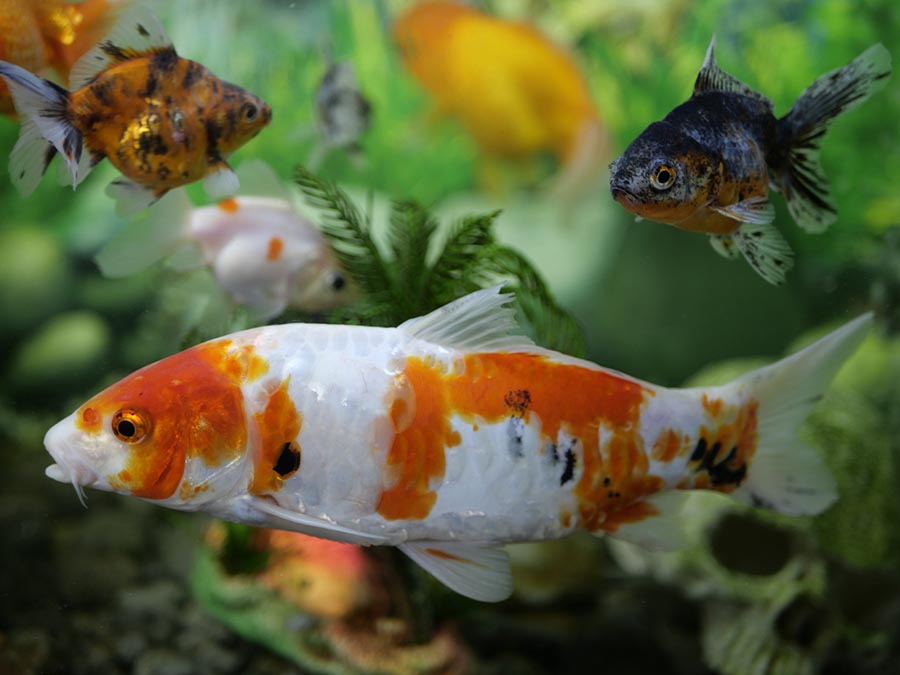
Nearly every ornamental pond in North America is built around two basic species. They are the popular classics for a reason: they combine stunning beauty with incredible resilience. When it comes to overwintering, you can’t go wrong with these cold-hardy members of the carp family.
Koi (Cyprinus rubrofuscus)
Koi are the prized residents of ornamental ponds, known for their size, unique personalities, and vibrant colors. Koi are surprisingly tough and well-suited for winter when they appear to hibernate, remaining at the bottom of the pond in a state of torpor. However, their large size comes with a high bioload, meaning they produce more waste and consume more oxygen than their smaller cousins. Successfully overwintering koi is directly dependent on the deep, high-volume, and well-oxygenated environment we designed in Chapter 2.
Goldfish (Carassius auratus)
Remember the unassuming goldfish you kept in a bowl as a kid? It was virtually bulletproof as long as you changed the water from time to time. That ever-present and famously hardy goldfish also makes a forgiving and fantastic choice for ponds of all sizes. But for winter survival, it’s essential to choose the right varieties. The sleek, single-tailed types, such as Comets, Shubunkins, and Sarasas, are highly resilient and naturally adapted for pond life. However, the slower, twin-tailed “fancy” varieties (like Orandas or Ranchus) are far more delicate and aren’t suited for overwintering in a pond. Stick with the basics on these.
Like koi, goldfish will spend the winter in a state of torpor at the bottom of the pond. Their small size and lower bioload make them a more forgiving option, especially for smaller ponds. The frost line is still critical, though. Even a hardy goldfish won’t come back from the deep freeze.
Friends & Neighbors: Exploring Native Species from Your Region
While koi and goldfish are the first to come to mind when you picture an ornamental pond, a supporting cast of native fish can add diversity, activity, and a unique connection to your local environment. Native species are, by definition, perfectly adapted to your regional climate, including its winter severity. They’re often more resistant to local diseases and parasites and can thrive without the intensive care some ornamentals require.
However, “native” is entirely dependent on your location. Clearly, a fish native to Florida isn’t suited for a pond in Minnesota. Here, we’ll share a general overview of common native North American pond fish families so you can find the right species for your own backyard.
Common Native Pond-Dwellers
Many hardy native species can make great pond inhabitants. Common examples include:
Sunfish
This family includes some of the most colorful and charismatic native fish. Bluegill and Pumpkinseed sunfish are beautiful, hardy, and even have interesting personalities. They are more active during the winter than carp and will readily populate a well-designed pond.
Minnows
Small schooling fish like Fathead Minnows (often sold as Rosy Red Minnows) or Golden Shiners add constant motion and shimmer to a pond. They are extremely tough and are a great “dither fish” that can make larger, shyer fish feel more secure.
A Critical Warning: Predator and Prey
Remember that most native pond fish are part of a natural food web. Unlike most koi and goldfish, sunfish are active predators. They will enthusiastically eat fish eggs, fry, and any small fish that fit in their mouths. Largemouth Bass, another member of the sunfish family, are apex predators that should only be kept in large ponds specially designed for them, lest they eventually eat all of their tank mates. Always research the predatory nature of a native species before adding it to a community pond.
How to Find True Local Natives
Since natives are uniquely suited to your climate, take the time to research local species in your area. Then, find a licensed hatchery or supplier to ensure your new residents are in top health.
Contact Your State’s Wildlife Agency
Your state’s Department of Fish and Wildlife (or equivalent agency, like the Department of Natural Resources) is the most authoritative source. Their websites and local biologists can provide lists of fish suitable for your area.
Consult Local Experts
University extension offices, local fish hatcheries, and knowledgeable staff at non-chain bait and tackle shops have invaluable, on-the-ground experience.
Check the Law
Besides being not a great idea, it’s often illegal to transport fish from a public body of water to your private pond. Always check local regulations and purchase your fish from a licensed hatchery or supplier.
Sourcing native fish takes a bit more work than popping over to your local fish store, but they can provide real enrichment to a natural pond’s ecosystem.
Understanding Fish Physiology in Winter
How can a fish possibly survive for months in near-freezing water without eating? The answer is that they are masters of energy conservation. Fish don’t hibernate in the same way mammals do, but they do have a unique set of physiological adaptations that allow them to endure the cold, dark winter. Understanding how their bodies work is key to helping them through it.
The “Cold-Blooded” Reality: Ectotherms
The most fundamental concept to understand is that fish are ectotherms (or “cold-blooded”). Unlike mammals, which generate their own body heat by burning calories, a fish’s body temperature is regulated by its external environment. As the pond cools to a stable 39°F at the bottom, so does the fish. This is why maintaining that stable, deep-water sanctuary we designed in Chapter 2 is a matter of life and death.
Torpor: The Art of the Metabolic Slowdown
To survive this deep cold, hardy fish enter a state of torpor. This is a state of drastically reduced metabolic activity, where the fish’s entire system slows to a crawl to conserve energy. Torpor is sometimes confused with hibernation, but they’re distinctly different. Hibernation is a voluntary (if instinctive) process, and hibernating animals can wake up if danger threatens. Torpor, on the other hand, is induced as a fish’s body temperature drops along with the surrounding water. Fish in torpor cannot rouse themselves, so it’s not so much a “long winter’s nap” as a seasonal power outage.
During torpor:
- Heart rate and respiration (gill movement) become extremely slow and shallow.
- Digestion ceases almost entirely. This is why feeding fish in cold water is dangerous.
- Movement is minimal, but not absent. Fish will appear motionless at the bottom of the pond for long periods.
By entering torpor, a fish can survive for the entire winter on the fat reserves it built up during the fall.
The Slime Coat: A Fish’s Winter Armor
A fish’s first and most important line of defense against disease is its slime coat, a layer of mucus covering its entire body. This coating is a critical part of its immune system, protecting it from bacteria, parasites, and fungal infections that are always present in the water.
A healthy, thick slime coat is essential for protecting a lethargic, slow-moving fish whose immune system is suppressed by the cold. This is why you should avoid handling your fish during the fall and winter, as it can damage the protective layer, leaving them vulnerable to infection when they’re least able to respond to it.
Now that we’ve learned about pond fish and the amazing physiological adaptations they use to survive the cold, you have the essential information to meet their needs. Now, we’ll shift focus from the “who” to the “how.” Our next chapter will introduce a practical, year-round cycle of care that will keep your fish happy, healthy, and ready to “Spring” into action!

