

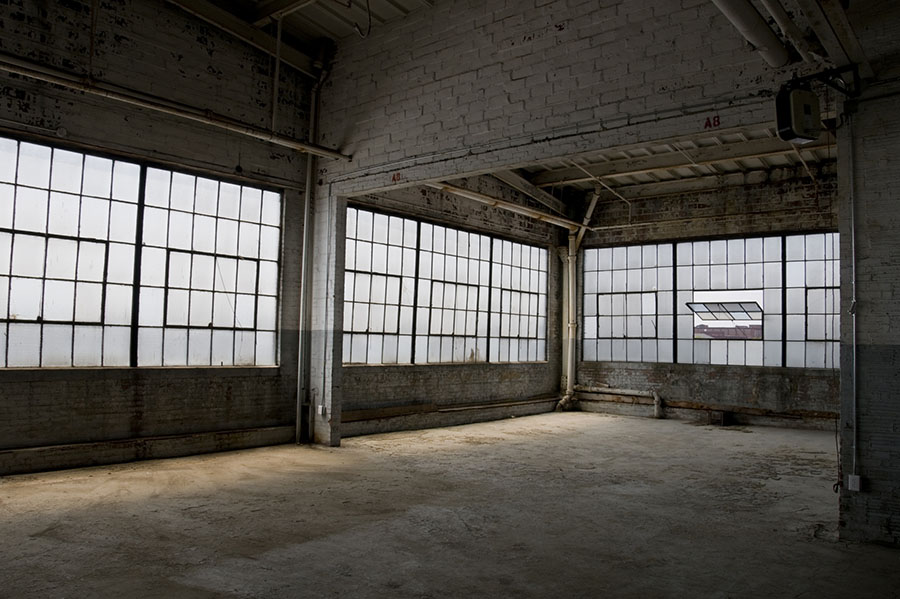
There’s a specific feeling you get when you sign the lease on your first commercial space. You stand in the middle of an empty 2,000-square-foot warehouse, look at the high ceilings and the concrete floor, and think: “Look at all this room! I’ll never fill this up.”
Go ahead—breathe in and let yourself enjoy that feeling for about five minutes. Because once you start building, you will realize that space fills up faster than you can imagine.
But before you start moving in, you have to create the right “container” for your business. Most warehouses and barns are designed to store pallets of cardboard or park tractors, not to maintain a tropical rainforest climate (85°F / 60% Humidity) through a freezing winter or blistering summer.
If you dive right in and set up racks in a standard metal building, you’re going to be fighting the environment every day of the year. In the winter, you’ll bleed money right through the walls trying to maintain a toasty 85°F. Your heating bill will destroy you, and condensation on the cold metal walls will rain down on your insects, causing mold and crashes.
In the summer, that uninsulated roof will turn your facility into a solar oven. When it’s 100°F outside, it can easily hit 120°F inside. Since your insects are already generating their own body heat, this thermal spike will cook your entire stock in hours.
We’ll start off our scaling guide for insect farmers by taking a look at the building envelope. You’re building a giant, sealed life-support system, and it deserves special attention.
Picking Your Building: What to Look For
For every property you consider, check out the building’s bones. There are three critical things to look for that are expensive to fix later—a burden no up-and-coming business wants to deal with. If the property doesn’t meet these standards, it’s best to move along.
The Power Drop (Amperage)
Running a commercial facility requires serious juice. You’ve probably gotten away with plugging in a few heat lamps before this, but now you’ll be running commercial HVAC units, dehumidifiers, and heavy machinery (like trommels).
The Rule
Look for at least 200-Amp service. If you can find a place with 3-Phase power, even better—it runs heavy motors more efficiently and more cheaply. If the building only has a standard 100-Amp panel, you’re probably going to blow your breakers the first day you turn on your heaters.
The Water Situation (Floor Drains)
Not surprisingly, drains are the most overlooked feature in insect farming. Think about it: you’re going to be washing thousands of trays. If you have to carry buckets of dirty water outside because your warehouse has no floor drains, you (and your staff) will quit inside a month.
The Rule
Concrete floors with active floor drains are an absolute must. You need to be able to hose down a room without flooding the drywall.
Logistics (The Roll-Up Door)
Remember those cute 50lb bags of chicken feed? Put them out of your mind, because, as of today, you’re moving to bulk feed. And no matter how great your team is, you can’t just drag 2,000 lbs of grain through a standard office door.
The Rule
You need a roll-up door high enough to fit a pallet jack or a forklift. It’s simple: if you can’t drive a pallet into the building, don’t rent it.
The Envelope (Insulation & Vapor Barriers)
In a commercial facility, every BTU of heat that escapes through your roof is profit leaving your bank account. You might even think of insulation as an investment that keeps your bank account warm!
You need to aim for a minimum of R-19 in the walls and R-30 in the ceiling.
The Spray Foam Solution
If you have the budget, closed-cell spray foam is the superior choice. It insulates and seals gaps in one step and creates a rigid, airtight cooler box that holds temperature efficiently.
The Fiberglass Trap (And How to Fix It)
Most leased warehouses come with cheap fiberglass batt insulation (the pink fluffy stuff). But it’s a problem for a simple reason: insects generate moisture. As you raise the humidity to 60% for your crickets, that moisture will try to migrate through the walls into the cold outside air. When it hits the fiberglass, it’s soaked up like a sponge. Wet insulation creates mold, rusts your metal beams, and loses all its R-value. Professional farms line their walls and floors with heavy-duty liners to create a sealed 'wet room' environment that can be hosed down without destroying the building.
Climate Control (The Space Heater Fallacy)
A 1500-watt oil-filled heater and a box fan can easily keep 50 bins warm in a garage. But in a giant warehouse, it’s a recipe for disaster. Now you’re facing two new challenges: stratification and metabolic overheating.
The Stratification Killer
Anyone who’s climbed a ladder to change a lightbulb knows that heat rises. In a facility with 14-foot ceilings, that means all your heated air pools in the rafters, leaving your floor cold.
The Result
The problem here is more than the electricity bill—the real problem is that it desynchronizes your farm. Insects are cold-blooded, meaning their growth rate is dictated entirely by temperature. If your top rack is 10°F warmer than your bottom rack, it’s like those insects are living in different time zones. This means that on harvest day, your top bins are ready to sell, but your bottom bins are still weeks away from maturity.
The Cost
Without consistent maturity dates, you lose the ability to batch harvest. Instead of clearing an entire aisle at once, you’re forced to hunt-and-peck for the ready bins, which immediately destroys the efficient labor model that’s the backbone of your profit model.
The Fix: Destratification
But remember: a bigger heater can’t fix temperature stratification—you need active circulation. This means industrial ceiling fans or V-Flow fans, designed to push that hot air back down to the floor. This is critical: your goal is to maintain a uniform temperature across the entire product zone.
Climate Control (Heating AND Cooling)
In a commercial facility, maintaining stability, no matter the outside temperature, is your ultimate goal.
Don’t Forget: Your inventory itself is a heater. Millions of crickets generate a massive amount of metabolic heat. On a 90°F day, that body heat combined with solar gain can spike your room temperature to lethal levels in minutes.
Hardware
Residential comfort systems have it easy; they’re designed to run for a few hours and shut off. But commercial insect farms require climate management 24/7/365. So ditch the window units and space heaters. You need mini-splits (which efficiently handle both heating and cooling) or dedicated industrial HVAC systems.
Capacity
Size your system for the extremes, not the averages. It needs to be powerful enough to heat the room during a polar vortex and cool the room during a heatwave.
Redundancy
Finally, always have a backup. If your AC compressor dies on a July afternoon, you need a Plan B, or you’ll wake up to a total colony collapse.
Zoning: The Rule of One-Way Flow
In your garage, you likely had your breeding bins right next to your harvest station. In a commercial facility, that’s not a good idea because of the risk of cross-contamination.
Design your floor plan with a strict one-way flow: always moving from clean to dirty, never the other way around. If you walk from a dirty harvest room back into the clean hatchery without changing boots, you’re tracking mites and pathogens right into your nursery.
Zone 1: The Office/Foyer (Cleanest)
This is your airlock. It’s where employees change shoes and wash their hands. No bugs allowed here!
Zone 2: The Hatchery (Clean & Hot)
The hatchery is your most sensitive area. This is where your breeding beetles and microscopic baby larvae are kept. Because these are your most valuable inventory, they require the strictest biosecurity measures. Only authorized, fully decontaminated staff enter here.
Zone 3: The Grow Room (The Main Floor)
This is the warehouse proper, where your thousands of trays live for 4–6 weeks. It’s high traffic, loud, and warm.
Zone 4: Processing & Washdown (The Dirty Zone)
This is where the stock is harvested. It’s dusty (frass) and wet (washing trays).
The Golden Rule
Once a tray (or a staff member) enters the processing room, it never goes back to the grow room until it has been sanitized.
The Exit
Ideally, the exit has a separate roll-up door so waste/frass leaves the building immediately without passing back through the clean zones. If that’s not an option, you’ll need to design strict handling protocols to avoid contamination.

