

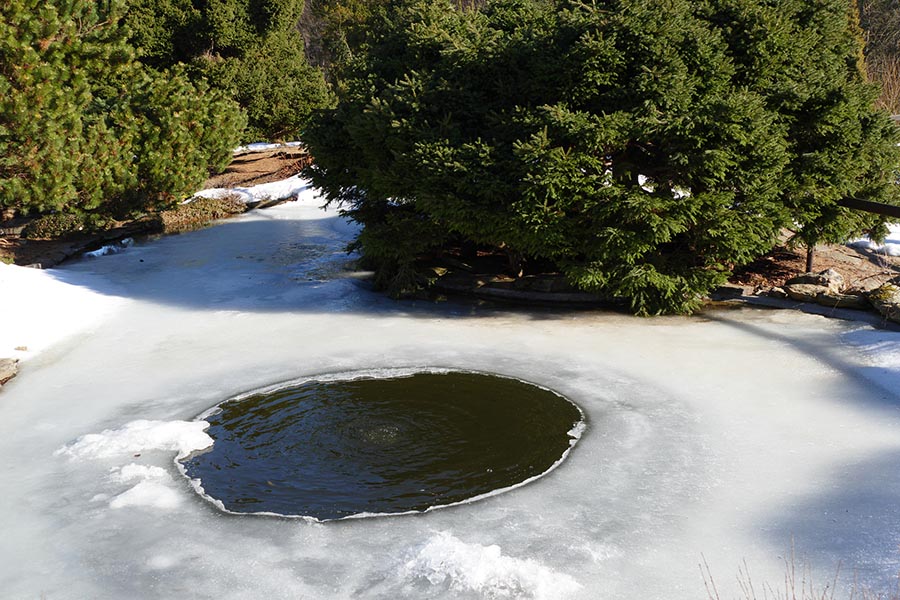
While a well-designed pond is your first and best line of defense against the perils of winter, good equipment is a powerful safety net. It ensures your pond is a healthy environment even when it’s sealed under ice. Here, we’ll cover the essential hardware for a winter-ready pond, including what each piece does and how to use it correctly. Finally, we’ll tackle the critical question of what to run and what to shut down.
Aeration Systems: The Lifeline of the Winter Pond
If you’re going to run only one piece of powered equipment during the winter, make it the aeration system. Actually, you may be surprised to learn that the primary purpose of a winter aerator is not to add oxygen to the water. In fact, its most critical job is maintaining an opening in the ice to keep that crucial gas exchange going. This hole allows toxic gases from organic decomposition to escape; allowing fresh oxygen from the atmosphere to enter is a nice bonus.
An aeration system uses a shore-mounted air pump to push air through a weighted tube to a diffuser placed in the pond. The rising column of bubbles carries the warmer, 39°F water from the lower layers up to the surface. This constant movement of slightly warmer water keeps ice from forming in a small area above the diffuser.
The Cardinal Rule for Placement
Choosing the wrong location for the diffuser during the winter months is a common point of failure for many pond keepers—it’s a critical error that can lead to a total loss:
NEVER place the diffuser in the deepest part of the pond during the winter.
Placing the aerator in the deepest hole will disrupt the stable, calm layer of 39°F water where your fish are resting in a state of torpor. It circulates and super-chills the entire water column, stressing your fish and defeating the whole purpose of creating a deep pond sanctuary.
Place your diffuser on a stable, shallow shelf or submerged block, about 12 to 18 inches below the water’s surface—but no more. This is deep enough to prevent the diffuser from freezing in the ice but shallow enough to avoid disturbing the vital warm-water layer at the bottom.
De-Icers and Heaters: Maintaining the Opening
While an aeration system uses moving water to keep a hole open, de-icers and heaters use a more direct method: gentle heat. They’re another excellent tool for keeping the vital gas exchange going all winter. However, their proper function is widely misunderstood, and using them incorrectly can be both ineffective and expensive.
How They Work: Gentle Heat, Not a Hot Tub
The most common device for backyard ponds is a floating de-icer. This is a small, temperature-controlled unit with a low-wattage heating element. When the water temperature immediately surrounding the unit drops to near freezing, the heater kicks on.
But its purpose isn’t to heat your pond. A pond de-icer is designed to be just warm enough to keep a small, 12-inch circle clear of ice around it. Attempting to heat your entire pond would be astronomically expensive and would dangerously interfere with your fish’s ability to remain in torpor.
Pros and Cons
De-icers are very good at their specific job, but they have trade-offs when compared to an aeration system.
Pro: Extremely Reliable
In the absolute coldest conditions, a de-icer can be more reliable than an aerator at keeping a hole open.
Con: Higher Energy Use
A de-icer, even a low-wattage one, uses much more electricity than the small air pump used for a winter aerator.
Con: No Water Circulation
A de-icer only melts a hole; it does nothing to help circulate the water and vent harmful gases from the lower layers of the pond.
The Belt-and-Suspenders Approach: Using Both
For the ultimate peace of mind, especially in very harsh climates, many pond keepers use both systems. They run a properly placed aeration system as their primary, energy-efficient method for maintaining an opening. They then place a floating, temperature-controlled de-icer inside the ring of open water created by the aerator.
This way, the de-icer rarely needs to turn on, so it consumes very little power. However, if the aerator were to fail or a severe cold snap were to overpower the air bubbles, the de-icer provides a reliable backup so the hole never freezes solid.
Pumps and Filters: To Run or To Shut Down?
This is one of the biggest and most critical questions a pond owner faces as winter approaches. Running your main circulation system can provide filtration benefits during a long, cold winter, but if done incorrectly, it can be fatal to your fish. The best decision depends entirely on your pond’s plumbing, specifically whether you have a bottom drain and skimmer circuit.
Scenario 1: The Standard Backyard Pond
(This applies to ponds where the pump sits on the bottom or in a skimmer box that feeds a waterfall.)
In a Nutshell: For the vast majority of backyard ponds, the answer is unequivocal: SHUT IT DOWN.
Running the main pump in a standard setup is extremely dangerous in the winter for two main reasons:
It Destroys the Sanctuary
Like an aerator (but more so), a pump placed at the bottom of the pond will pull the stable, 39°F water from the deep sanctuary where your fish are resting. It then pumps this relatively warmer water up to a waterfall or feature where it is exposed to the freezing air, rapidly chilling it. This process will quickly disrupt the pond’s vital thermal layers and super-chill the entire water column, potentially killing your fish.
Risk of Freezing and Leaks
External pipes leading to waterfalls and filters are highly vulnerable to freezing. An ice blockage can crack a pipe or fitting, and if the pump is still running, it can drain your entire pond in a matter of hours.
The Shutdown Procedure
Once water temperatures are consistently in the 40s, disconnect your pump and bring it inside for the winter. Store it in a bucket of water to keep the seals from drying out. Drain all water from your filters and plumbing to keep ice from cracking the equipment.
Scenario 2: The Advanced All-Season Pond
(This applies ONLY to ponds with a bottom drain AND a separate skimmer circuit.)
If your pond is equipped with more advanced plumbing—specifically, a bottom drain and a surface skimmer that can be isolated from each other—you have the option to keep your circulation system running safely throughout the season.
In a Nutshell: The whole reason this method works is that it changes what water you are pumping.
Transitioning to Winter
Close the Bottom Drain Circuit
Using a valve, you must completely shut off the line coming from the bottom drain. This is the most crucial step, as it leaves the deep, warm-water sanctuary undisturbed.
Open the Skimmer Circuit
You will now run your pump by only pulling water from the surface skimmer. This draws the coldest surface water into your filtration system while leaving the deep water calm.
Bypass the Waterfall
The filtered water should be returned to the pond via an underwater return line, not over a waterfall where it would be super-chilled by the air.
This advanced setup allows you to maintain surface skimming and some biological filtration throughout the winter without endangering your fish, which can be a considerable benefit. However, it’s only possible with appropriate plumbing installed from the start.
Pro Tip: For large community ponds with a high organic load, running the filtration system through the winter offers a significant benefit: continuous ammonia removal. Although the beneficial bacteria in your filter work more slowly in cold water, they still process the ammonia produced by decomposing debris, thereby reducing the toxic load on your fish. Remember, this is ONLY safe if you can pull water from a surface skimmer, not the bottom drain.
Essential Monitoring Tools
While the overall winter philosophy is “hands-off,” that doesn’t mean “eyes closed.” In fact, you should keep an eagle eye on your pond when your fish are generally unseen. They’re kind of like small children in that regard - it’s when they’re being unusually quiet that you need to be particularly vigilant. Fortunately, you need only a few simple tools for effective monitoring. They allow you to confirm that your pond is healthy or accurately diagnose a problem if you see signs of trouble.
A Reliable Pond Thermometer: This is your most important tool. All of your key management decisions, especially the critical feeding transitions, are based on accurate water temperature readings. A digital thermometer with a probe on a cord is often the easiest to use in the cold.
A Liquid Water Test Kit: If you see signs of distress, like fish gasping at the air hole, you need to be able to diagnose the problem. For winter emergencies, you must be able to test for Ammonia, Nitrite, and pH, as these are the most likely culprits in a sealed pond.
A Good Flashlight: A powerful, waterproof flashlight can help you perform quick visual checks of the equipment and the area around the air hole after dark without having to leave outdoor lights on.
Like a baby monitor, these simple tools let you keep a weather eye on your pond so you can spot trouble before it becomes a disaster.

