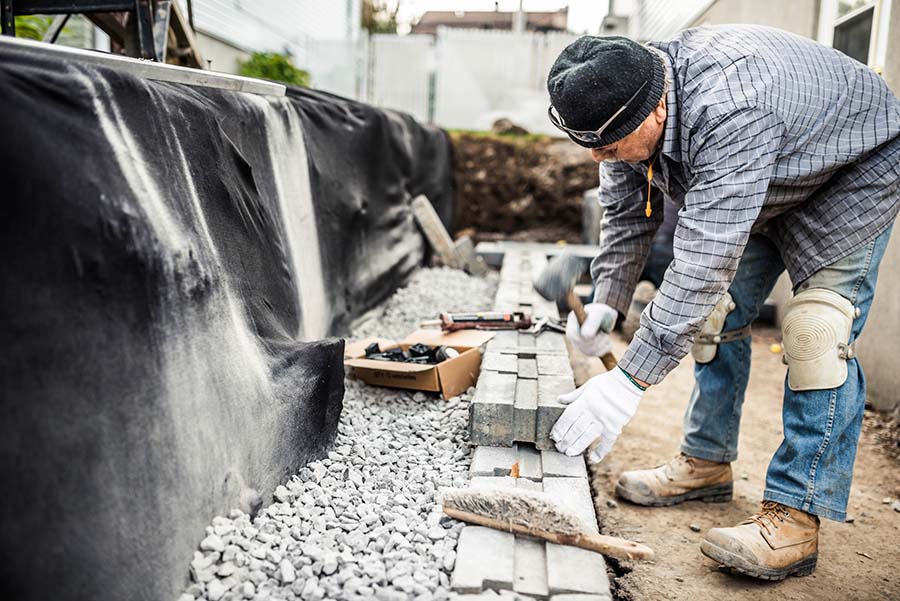
You can install the most beautiful, level, and structurally sound retaining wall in the county, but if it’s holding back rainwater as well as soil, all you’ve built is a very expensive, temporary dam. And it will fail.
Worse, this kind of failure isn’t a simple trip hazard from a sunken paver; it’s a potentially catastrophic blowout. It could show up quickly, or it may take a few wet seasons, but eventually the hydrostatic pressure—the sheer, crushing force of water trapped in the soil behind the wall—will build up until it literally pushes the entire wall over. It’s a massive failure that can destroy a landscape (and your reputation) in one wet splat.
Like the other problems we’ve seen in this e-book, this failure isn’t caused by poorly installed blocks; it’s caused by water collecting with nowhere to go. Clearly, your number one job when building a retaining wall is to give water a fast, easy, and permanent escape path.
This is where we get into the pro-level use of geotextiles. As we saw at the end of Chapter 5, a retaining wall is a complex system that often requires both geotextile tools: a high-strength woven fabric for soil reinforcement and a high-flow nonwoven fabric for filtration. Here, we’ll break down both of those critical jobs—filtration to prevent blowouts and reinforcement to ensure stability—to show how they create a wall that stands for a lifetime.
The #1 Job: Nonwoven Filtration to Prevent a Blowout
Let’s get right to the problem we mentioned: that temporary dam effect. We’re talking about hydrostatic pressure. It’s the same force you feel in your ears at the bottom of a deep swimming pool—it doesn’t just push down, it pushes outward. And just like in a pool, the deeper the trapped water gets, the more powerful that outward push becomes, until it literally shoves the entire wall over.
A stronger wall won’t solve this. You must solve the water problem by giving it a permanent escape route.
But here’s the trap, and it’s a nasty one. It’s not enough to give the water an escape route. You have to let the water out without letting the soil wash out with it.
If all you do is backfill your perforated pipe with clean drainage stone, you’ve just created a different kind of disaster. Every drop of water that escapes will carry fine silt and sand particles with it. In other words, you’re not just draining the wall; you’re internally eroding it. This creates voids—empty pockets—behind the wall, and eventually, the ground above will collapse, turning your client’s level lawn into a sunken, wavy mess. Congratulations. You’ve just traded a catastrophic blowout for a slow-motion cave-in. Ouch.
But all is not lost! This is precisely where filtration steps up to save the day.
The Wrong Tool (Woven)
If you use a high-strength woven fabric here, it will fail, just like it does in a French drain. Its tight weave is not designed for high-flow water; it will ‘blind’ or clog with fine silt, turning your drain into a dam. It’s a fast pass to failure.
The Right Tool (Nonwoven)
The fuzzy, felt-like nonwoven fabric is the only tool for this job. Its matted, three-dimensional structure lets it do two things at once:
- Let water pass through freely with a high flow rate.
- Trap fine soil particles within its web, preventing them from clogging your drain.
The Design: The Chimney Drain
The standard, bulletproof method for managing hydrostatic pressure is to build a chimney drain directly behind the retaining wall blocks.
- Place a perforated pipe at the base of the wall, daylighting to a safe outlet.
- Backfill the area directly behind the wall (typically 12-18 inches wide) with clean, crushed stone.
And here’s the critical step:
- Wrap this entire column of stone—bottom, back, and top—in a nonwoven filter fabric. This fabric wrap becomes a continuous filter, separating your clean drainage stone from the native backfill soil.
The chimney drain allows groundwater to flow out of the soil, hit the filter fabric, pass through the fabric into the clean stone, and drop into the perforated pipe where it’s carried safely away. The hydrostatic pressure is eliminated, and your wall is safe.
The #2 Job: Woven Reinforcement to Prevent a Collapse
Solving the hydrostatic pressure problem is critical, but it’s only half the battle. A retaining wall is still responsible for holding back thousands of tons of soil, and that soil mass is always actively trying to push the wall over. This is a classic stabilization problem that demands a high-strength woven geotextile.
The Wrong Tool (Nonwoven)
If you tried to use that fuzzy, felt-like nonwoven fabric for reinforcement, it would fail instantly. As we’ve seen, nonwovens have high stretch and low tensile strength. They’re built to filter, not to fight gravity. They would stretch thin, change shape, and do nothing to hold the soil mass in place.
The Right Tool (Woven)
This is the job for a powerful reinforcer: the slit-film woven fabric. Its high tensile strength and low stretch are precisely what you need to give the soil backbone.
The Design: The ‘Rebar’ for Your Soil
In this application, the woven fabric is used as geosynthetic reinforcement. It’s the same principle as the rebar you put in concrete. The soil itself is strong in compression (when you push on it), but weak in tension (when you pull it apart). The woven fabric provides the tensile strength that the soil lacks.
Unless you’re hungry, it might help to think of a pan of lasagna as you build the reinforced soil mass behind your retaining wall (featuring your slit-film woven as those yummy flexible noodles).
- Starting at the bottom, lay your first few courses of retaining wall blocks.
- Backfill behind these courses with soil and compact it until it’s level with the top of the blocks (e.g., 2 feet high).
- Unroll your high-strength woven fabric horizontally and lay it on top of your compacted soil. Run it from the face of the wall block back into the slope (often 6-8 feet or more).
- Dump the next layer of backfill soil on top of that fabric and compact it.
- Stack the next few courses of wall blocks.
And repeat the process—compacted soil, then another horizontal layer of woven fabric, then more soil on top of that.
This layered system of fabric and compacted soil creates a massive, reinforced ‘gravity block’ behind the wall face. The fabric interlocks with the soil and, through friction, holds the entire mass together in a sandwich, preventing the soil from slumping or shifting and preventing it from exerting an active push against your wall. This, combined with your nonwoven chimney drain, creates a durable, virtually invincible system.