

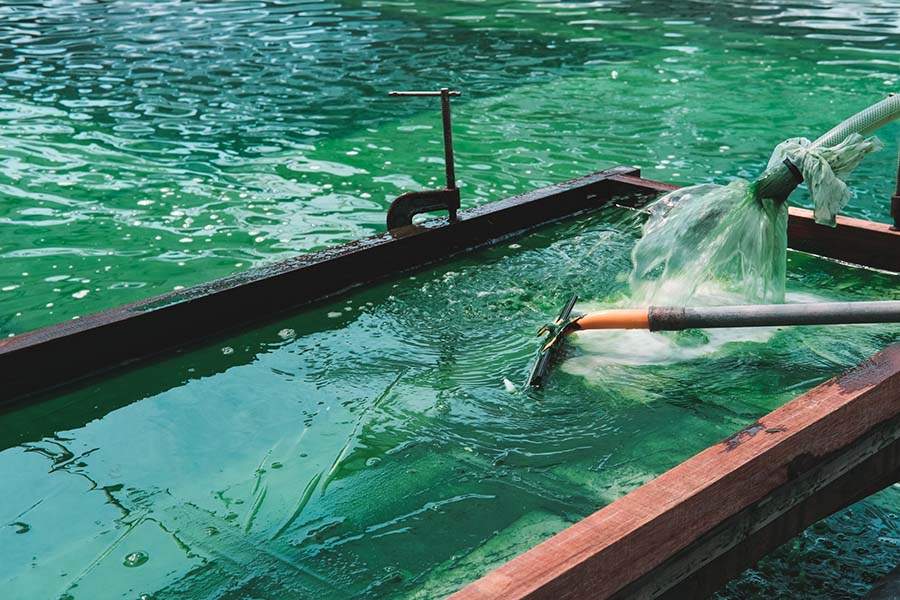
After weeks of careful management, the pond is dense, green, and ready for the payoff! The final step of cultivation—the harvest—is when the fruits of your labor are collected. Would that it were a simple matter of scooping green gold from the water. Alas, the harvest is arguably the single biggest technical and economic bottleneck in the entire production chain.
The core challenge in commercial algae production is one of scale and dilution. A typical algae culture is incredibly dilute, often containing less than 0.1% solids by weight. That means operators must handle and process roughly 120 gallons of water (approximately the amount in a small 2-person hot tub) to harvest just one pound of algae biomass. The sheer amount of energy required to separate these microscopic cells from such vast volumes of water is immense, and the cost of just this step can account for 20-30% of total production costs.
This physical reality means that a profitable operation hinges on achieving maximum efficiency in this step. In this chapter, we’ll break down the technologies and strategies used to tackle the challenge and how a lined pond can help.
Step One: Flocculation
The first challenge in harvesting is pulling microscopic algae cells out of the water efficiently. Trying to filter individual, suspended cells from such a massive volume of water would require vast amounts of energy and clog filters almost instantly. The professional approach, therefore, isn’t to chase single cells but to encourage them to gather together first in a process called flocculation. In this technique, a substance known as a flocculant is added to the water. The flocculant neutralizes the natural negative charge on the surface of the algae cells, which keeps them apart. With their charge neutralized, the cells are free to clump together into larger, heavier aggregates called “flocs,” which can then be easily separated from the water.
Operators generally choose between two categories of flocculants:
Chemical Flocculants
Inorganic salts, such as aluminum sulfate (alum) and ferric chloride, are highly effective and relatively inexpensive. Their major drawback, however, is that they can contaminate the final biomass with metals. This may be unacceptable for products intended for human or animal consumption and may pose other environmental concerns.
Bio-Flocculants
To avoid contamination, many operations opt for natural, biological alternatives, including natural polymers such as chitosan (derived from crustacean shells) or plant-based starches. More advanced methods involve co-cultivating the algae with specific flocculating bacteria or fungi, creating a more integrated and eco-friendly harvesting system.
Once flocculated, the heavy clumps of algae cells are typically allowed to settle to the bottom of a tank via gravity sedimentation, concentrating the biomass and leaving clearer water on top. This allows the bulk of the harvest to be collected without having to process the entire volume of pond water.
Field Note: Chemical flocculants are a major harvest cost, but you might not need them if your culture can be triggered to auto-flocculate. The technique is simple: by stopping CO2 injection, you allow photosynthesis to drive the pond's pH up. For some strains, this sharp pH spike is enough to cause the cells to clump together and settle on their own, saving you the cost of additives. It's highly dependent on your specific strain and water chemistry, but it's a powerful cost-saving trick worth testing.
Step Two: Dewatering and Collection
Even after flocculation and sedimentation, the harvested algal slurry is still mostly water—often more than 95%. Before the biomass can be processed into a final product, it must be dewatered further to create a thick, concentrated paste or cake. This secondary dewatering step is where the high costs and energy consumption of harvesting are clearest. In fact, while several dewatering technologies exist, each has significant trade-offs that affect cost, energy use, and efficiency.
Centrifugation
Centrifugation uses high-speed spinning to separate the relatively denser algae cells from the water, leaving a thick paste with 15-25% solids. While it’s effective, the trade-off is severe: centrifuges have very high capital costs and are extremely energy-intensive, which adds significantly to the overall production cost. High shear forces can also damage fragile algae cells, making this technique a poor choice for certain high-value products.
Filtration
Filtration uses membranes with microscopic pores to physically separate the algae cells from the water. This method captures a high percentage of the algae biomass but at the cost of frequent membrane fouling. This occurs when the filter pores become clogged with algae and organic matter, which slows down the process and requires costly, frequent cleaning or even complete replacement of the filter membranes.
Dissolved Air Flotation (DAF)
Another common method is Dissolved Air Flotation (DAF), which is essentially the reverse of sedimentation. After flocculation, micro-bubbles are introduced into the slurry, which attach to the algal flocs and carry them to the surface. This creates a thick scum that can be easily skimmed off. DAF is an effective process, but the trade-off comes in the form of higher capital investment, energy bills, and increased maintenance needs.
Ultimately, the choice of a dewatering method is much more than a technical decision; it’s a critical business calculation that derives from the “two-speed economy” of the algae industry. For high-value products like nutraceuticals or cosmetic ingredients, an operator can justify the high capital and energy costs of centrifugation, for example, to ensure a pure, high-quality product. The healthy profit margins of the final product can absorb the expense.
For low-value commodities like biofuel, however, these expensive methods are non-starters since the cost of harvesting alone can exceed the market value of the fuel produced. This reality has made the development of low-cost, low-energy harvesting technologies the single most critical area of research for the bulk commodities sector. It suggests that the most significant near-term improvements in the profitability of the algae industry may come not from innovations that grow algae faster but from breakthroughs that harvest it more cheaply.
The Liner’s Role in a Clean Harvest
While a lined pond is clearly essential for a biosecure cultivation environment, the liner is just as valuable when it’s time to bring in the harvest. The choice between a lined and unlined pond directly impacts both the quantity and quality of the biomass that can be recovered. In fact, an unlined pond makes a clean, efficient harvest nearly impossible.
When flocculated algae settle to the bottom of an earthen pond, they mix with the mud, silt, and organic debris on the floor. Trying to collect this settled biomass inevitably means gathering a significant amount of dirt along with it. This not only contaminates the final product but also results in significant product loss. In fact, it’s estimated that 10-30% of the settled biomass can be lost when it becomes inseparable from the muck at the bottom of an unlined pond.
A smooth geomembrane liner provides a clean, non-porous surface that solves this problem. The settled algae form a distinct layer on the liner, allowing operators to collect the biomass without contamination from the underlying soil, directly translating to a higher yield and a purer product. This is especially critical for high-value applications such as food ingredients or nutraceuticals, where quality standards are absolute. Ultimately, the liner protects the purity and value of the final harvest, ensuring the operator can collect as much of the crop as they grew.
Looking Ahead
The economic reality of the technical challenges and costs associated with harvesting in algae production is a sharp reminder that producing a crop of algae is only half the battle. Overcoming this economic bottleneck, however, is the price of admission to the final and most crucial stage: turning the raw biomass into profitable products.
So, how can an algae operation be consistently profitable? Clearly, producing a single low-margin commodity doesn’t work, given today’s technology and economic pressures. Many successful ventures have found the answer lies in a sophisticated business strategy: the “value-stack” biorefinery.
In the next chapter, we’ll examine how a “value-stack” model optimizes revenue by creating a diverse portfolio of products, ranging from high-value extracts to bulk animal feed, all derived from a single harvest.

