

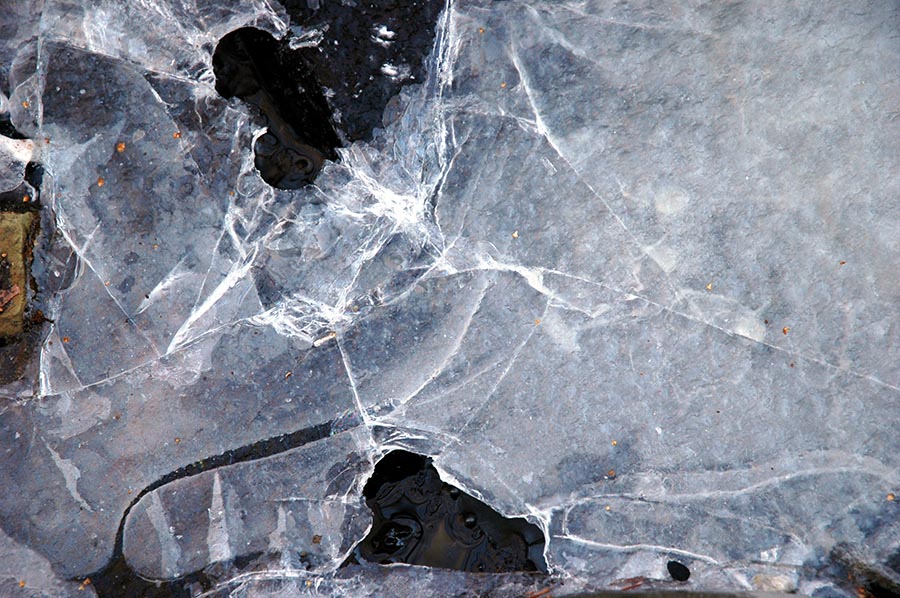
The Silent War
A well-designed pond has a peaceful air about it. The rocks are heavy, the water is calm, and the sun is shining. But there’s more going on than meets the eye. Underneath it all, your liner is engaged in a silent, continuous battle against the earth itself.
Everywhere, every day, the ground breathes. It swells with rain, shrinks with drought, and heaves with frost, especially around your pond. At the same time, the pond’s liner expands and contracts with every shift in temperature. No single deep freeze or heavy storm is likely to trigger a failure; it’s the cycling.
The constant push-pull of ground (heave) against material (thermal expansion) creates cumulative stress. Over five or ten years, this invisible motion attacks the two weakest points of your system: the seams you taped and the corners you folded.
So let’s look now at how a liner survives the decades after install, specifically how your choice of material handles the three most brutal forces nature can throw at it: the crushing grip of the thermal vise, the material failure of the glass effect, and the saw blade of surface ice.
The Thermal Vise (Frost Heave)
In northern climates (Zone 5 and below), when the ground gets cold, it moves. Combine this with a liner material that thermally contracts, and you have a problem.
Ground movement happens when the water trapped in your soil freezes and expands. The expanding soil pushes upward with massive force, a phenomenon called Frost Heave. How your liner handles this squeeze depends entirely on its elasticity.
The Rubber Band (EPDM)
This is where EPDM shines. High-quality rubber remains flexible down to -40°F and retains its ability to stretch. In other words, when the temperature drops, EPDM contracts slightly, but because it acts like a rubber band, it simply stretches to match the new shape of the ground without stressing the seams. Later, when the ground thaws and settles, the rubber retracts. It’s a very forgiving material for shifting soil.
The Unyielding Bridge (RPE)
As we’ve seen, Reinforced Polyethylene (RPE) is amazingly strong, but it has almost zero elongation (stretch). So, if the ground heaves up under a tightly installed RPE liner, the material is forced to span the gap like a bridge, creating a void behind the liner and transferring the full tension directly to the anchor points and seams.
The problem is, if you step on that unsupported bridge during winter maintenance, the material—already under maximum tension—can rip.
The Fix: The Slack Rule
Does this mean you can’t use RPE in the North? No, it just means you have to install it differently. The key is to never pull it absolutely tight. Leave some slack to allow for movement—a few extra pleats and looseness in the corners, for example. You are essentially pre-building the expansion room that EPDM provides naturally. A liner with a bit of slack can accommodate minor ground movement without creating a tension bridge.
Stiffness and Cold Cracking
As if frost heaving wasn’t enough to think about, each liner material responds differently to extreme drops in temperature. Depending on where you live, this may be a significant point of consideration.
PVC (The Glass Effect)
PVC is the only material on this list that relies on liquid plasticizers to remain flexible, so it doesn’t have a sudden state change like water turning to ice. Instead, as the temperature drops, the material gets progressively stiffer as the plasticizers lock up.
While brand-new PVC might be rated to withstand temperatures as low as -20°F without “cold cracking,” those plasticizers do leach out over time. Essentially, this means a five-year-old PVC liner has a higher freezing point than a new one. Since you’ll never have a reading on the exact state of your liner’s plasticizers, here’s a good rule of thumb: if the water is frozen, assume your PVC liner is brittle.
HDPE (Environmental Stress Cracking)
High-Density Polyethylene is chemically very different from the others. Because it has an extremely low cold-crack rating (often below -100°F), it will not shatter like PVC. Instead, it’s susceptible to slow-moving (and invisible) Environmental Stress Cracking (ESC). If an HDPE liner is under tension (stretched tight) and exposed to freezing cycles, microscopic fractures can form within the crystalline structure.
Fortunately (or maybe not), these cracks often don’t cause an immediate leak. Instead, they form weak points that grow slowly over time. A liner can develop microscopic crazing in January but not physically fail until July, when thermal expansion or water pressure finally splits the weakened plastic.
EPDM & RPE (The Survivors)
Both EPDM and RPE are the clear winners in the “winter challenges” category. Both remain flexible down to -40°F and, most importantly, don’t suffer from the structural weaknesses of their competitors.
EPDM
As a thermoset rubber, EPDM is chemically immune to Environmental Stress Cracking. It can stretch and compress through endless freeze-thaw cycles without developing the microscopic fractures that plague solid HDPE.
RPE
While technically a plastic, RPE uses highly flexible LLDPE coatings and an internal scrim that serves as a crack-arrestor. Combined, these make it highly resistant to the stress cracking that threatens solid HDPE.
Surface Ice (The Saw Blade)
For your liner, the final environmental threat of winter attacks in plain sight—on the surface. While we often worry about the effects of cold water on our pond residents, the real danger to your liner is the ice sheet’s physical behavior.
The Mechanics of the Cut (Grinding and Thrusting)
Ice typically forms at the edges first, where the water is shallowest. As it freezes, it locks onto the irregularities of your shoreline—gripping rocks, folds, and creases in the liner.
The Vertical Grind
Once the ice sheet spans the pond, it becomes a massive, floating plate. If the water level drops even an inch (due to winter evaporation or a slow leak), that heavy, sharp sheet drags down against the liner. If the water rises, it scrapes up. This constant vertical shifting turns the edge of the ice into a saw blade grinding against your perimeter.
The Horizontal Thrust
As the season continues and the solid ice sheet experiences repeated thermal cycles (warming during the day, cooling at night), it expands and contracts. This exerts massive lateral pressure against the walls, essentially trying to pierce the liner.
The Geometry Defense (Slopes vs. Walls)
The most effective defense against attacks by surface ice isn’t the liner material or installation; it’s the shape of the hole.
The Vertical Trap
If your pond has vertical walls at the waterline, the ice has nowhere to go. Whether it is expanding horizontally or shifting vertically, the force is directed straight into the liner, pinning it against the frozen soil like a fly against the wall (yikes!).
The best defense is a gentle slope (beach) at the water’s edge. This allows the shifting ice to slide up the bank like a slow-moving wave, rather than push directly through the wall.
The Material Defense
If you must have steeper walls (or if you want a little extra insurance), RPE is your best option.
While flexible, EPDM rubber is relatively soft. Under the constant grinding of a sharp ice sheet, it can be abraded or sliced, especially if the ice locks onto a fold. In contrast, RPE’s internal woven scrim makes it exceptionally resistant to abrasion. In fact, RPE acts more like a shield than a blanket here; the slick, hard surface makes it harder for the ice to grip and tear.
Conclusion: Build It Once
Your liner is the foundation of your pond and all the life it contains, and while there is no single perfect candidate, your project’s priorities will point clearly to the most suitable option.
- If you prioritize an easy-going liner that forgives imperfect digging and conforms to complex curves, EPDM is the traditional choice. Its elasticity makes it the master of the irregular shape.
- If you prioritize a liner that will stand as a fortress—a material that resists roots, blocks punctures, and withstands the grinding of ice and rocks—RPE is the modern standard. Its strength allows it to survive environments that would destroy softer materials.
Whichever liner you choose, remember that the material is only half the battle. Protect it with underlayment, seal your penetrations with mechanical compression, and allow the earth to breathe by leaving slack in the corners. Do this, and you may never see the bottom of your pond again—which is precisely the point, isn’t it?

