

You’ve leveraged your breeding expertise, built a commercial-sized facility, and learned how to harvest with the big boys. Give yourself a pat on the back! Because now things will be easier, right? You just have to do it every single day, forever.
Clearly, there’s more to distinguish a hobbyist from a commercial farmer than the number of bins—it’s the consistency of the workflow. A hobbyist is ready to feed the bugs when they look hungry. A farmer feeds them because it is Tuesday at 8:00 AM and the schedule demands it. This is what it takes to turn your beloved farm into a boring, predictable (money-making) machine.
The Daily Grind
Your day should always begin with a 30-minute inspection loop. This is the overview, a chance to gather impressions, notice details, and gather data. You’re not fixing problems yet, so this can be a relaxing start to the day.
The Climate Check
Don’t blindly trust the thermostat. Take time to walk each of your rooms. How do they feel? Are the hot spots hot? Are the humidifiers running? Does anything just feel off?
The Smell Test
If you can smell ammonia, you’re overdue for cleaning. But if you smell rot or sourness, you’re looking at a humidity crash or a dead bin, and it’s an emergency. Your own nose is usually your best sensor (but do bring along a coworker if your own nose isn’t quite up to snuff).
The Mortality Scan
Glance at the bottoms of your bins—all of them. A few dead bugs are normal, but a layer of dead bugs is a crisis (see Chapter 5).
Data Logging (If It Isn’t Written Down, It Didn’t Happen)
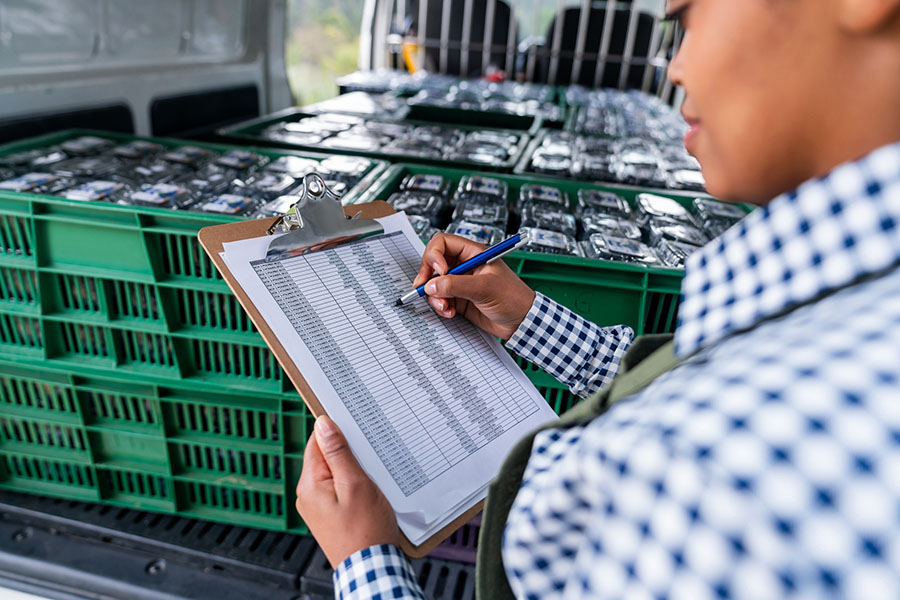
Keep a clipboard or a tablet in every room in your facility and log three numbers every single day, without fail:
- Temperature (High/Low)
- Humidity (%)
- Feed consumed (Lbs)
Why these details? Because when production drops 20% next month, you can look back and see that humidity dipped for three days in a row two weeks ago. That alone is enough information to pinpoint the problem. Without those data points? You’re just guessing.
The Anatomy of a Good SOP
Yes, data is critical, but it’s still only half the battle. The other half is the process. And by process, we don’t mean habit. Right now, your farm runs on your tribal knowledge. That means the protocols exist in your head. You know that you have to scrub the corners of the bins because that’s where the moth larvae hide. But does your spouse know that? Will your neighbor know that when they cover for you while you’re in the hospital with appendicitis?
In a word, an SOP isn’t for you. It’s for the person replacing you.
Without a clearly documented operating procedure to guide your trusted stand-in, your business could collapse inside of a week. That’s not an acceptable outcome, so now is the time to convert all that tribal knowledge into a cohesive, readily available set of Standard Operating Procedures (SOPs).
An SOP is a clear to-do list that enables someone else to do your job (albeit with probably only 90% of your proficiency).
To be an effective SOP, it can’t be a wall of text (like this one). It needs to be an easy-to-follow instruction manual. Every SOP in your facility should follow this specific five-part structure:
- The Goal: Why are we doing this? (Context prevents corner-cutting).
- The Gear: What tools do I need before I start?
- The Trigger: When does this task happen?
- The Workflow: The step-by-step instructions.
- The If/Then: Troubleshooting logic for when things go wrong.
With this structure in mind, let’s look at a model SOP for your most common maintenance task—The Bin Wash—and see how this looks in practice. This is a good example, because once the bugs are harvested and packed, there are 100 dirty bins coated in frass, shed skins, and biofilm. You know the cycle is complete only when each bin is reset for the next batch, but your stand-in may not.
Bin Hygiene (SOP-001)
Goal: Remove all organic matter and pathogens from used bins to prevent disease transfer to the next colony.
Gear: Putty knife/scraper, pressure nozzle, biodegradable detergent, bleach (or sanitizer), drying rack. PPE: Protective gloves, waterproof boots, and an apron.
Trigger: Immediately after harvest.
The Workflow
- Dry Scape: Remove stuck-on substrate immediately. Why? If wet frass dries, it becomes concrete.
- Soak & Wash: Spray with hot water and detergent to break the biofilm. Scrub corners thoroughly. The Standard: a bin is only clean when there is no discoloration, no dark spots in the corners, and no slimy residue on the plastic.
- Sanitize: Apply a 10% bleach solution (or commercial sanitizer). Let it sit for 60 seconds (sufficient contact time is critical to kill bacteria).
- Dry: Stack bins upside-down in a cross-hatch pattern for effective drainage. Never nest wet bins; they will mold before you use them.
- Return to Inventory: Perform a touch-test to ensure the bin is bone-dry. Once confirmed, move to the clean storage area (not the Grow Room).
Troubleshooting
- IF you find mold in a “clean” bin... THEN re-wash and re-sanitize immediately.
- IF the substrate is stuck like cement... THEN soak the bin in hot water for 30 minutes before scraping. Do not force it, or you will crack the plastic.
SOP-ing the Rest of the Farm
The Bin Wash is just one cog in the machine. As you scale, you need to apply this same obsessive level of detail to every critical interaction in your facility.
Don’t assume details like deliveries or storage will handle themselves. You need an SOP for Receiving Feed (How do you check for mold? Where do you store it to prevent pests?). You need an SOP for Waste Disposal (Where does the trash go so it doesn’t attract flies?). You need an SOP for Visitor Protocols (who is allowed in and what protective gear they must wear).
It may feel tedious to write these down now, but the first time a delivery driver drops a pallet of grain in the rain because he didn’t know where the loading dock was, you will wish you had handed him a checklist.
The Frass Goldmine (Waste Management)
In a traditional livestock farm, manure is a headache. You have to pay to haul it away or manage complex lagoons to prevent runoff. But in an insect farm, manure (frass) is a happy asset!
For every pound of insects you produce, you’ll generate roughly two to three pounds of frass. If you throw this in the trash, you are throwing away roughly 15% of your potential revenue.
What is Frass?
Frass is a mixture of insect manure, shed exoskeletons (chitin), and leftover bran. To a gardener, this is black gold. It’s a dry, odorless, slow-release fertilizer. Even better, the chitin triggers a valuable immune response in plants, making them grow faster and resist pests.
Ready to add a new revenue stream? We have great news: the workflow is simple!
Sift, Bag, Sell
You’ve already done the hard work during the harvest (Chapter 6) when you ran the bins through the trommel.
The Collection
The fine powder that falls through the screen is your raw product.
The Quality Check
Ensure the frass is dry. If your bins were running humid, the frass might be clumpy. Spread it on a tarp and air-dry for 24 hours if necessary. It must be a free-flowing powder, or it will mold in the bag.
The Packaging
Scoop it into 1 lb or 5 lb heat-sealed bags.
The Marketing
You generally don’t need a fertilizer license to sell Soil Amendments or Compost Boosters (but always check your local laws). If you want to claim specific NPK numbers (like 2-2-2), however, you’ll usually need to send a sample to a lab for analysis.
The Bottom Line
You don’t need to build a massive fertilizer brand. Just bagging it and selling it to local nurseries or cannabis growers (who prize the chitin content) can cover your facility’s electricity bill. It turns a waste stream into a revenue stream.
Contain the Mess
Hold On! Don’t celebrate too fast. Frass is fine and dusty. If you store it in a pile, it will leach into your concrete. You can build simple wooden collection bays lined with an impermeable liner material to make scooping and cleaning effortless.
Value-Added Horizons
As you scale, you will eventually hit a ceiling on how many live bugs you can sell. That’s why the Big Boys sell more than raw commodities; they process their surplus into shelf-stable products. Fortunately, you don’t need a high-tech factory to start thinking about diversification. Here are three avenues where established farms expand their margins:
The Super-Chow Mix
Instead of selling raw cricket powder, many farms formulate their own Reptile Growth Formula. By mixing your dried, ground insects with calcium powder, spirulina, and dried fruit, you create a proprietary brand. Instead of competing on the basic price of a cricket, you’re competing on the quality of your secret formula.
The Pet Treat Market
The dog and cat treat market is massive and far less regulated than the human food market, creating a fantastic opportunity for you. Insect protein is hypoallergenic, making it perfect for dogs with sensitive stomachs. Simple formulations made with insect powder bound to sweet potato or pumpkin allow you to enter the rapidly growing boutique pet trade.
Oil Extraction (The BSF Frontier)
For Black Soldier Fly farmers, the future is fractionation. Industrial equipment can press larvae to separate the protein meal from the insect oil. The oil is a potent additive for aquaculture and poultry feed, while the defatted meal is a high-grade protein source. While this requires heavy machinery, it is the ultimate goal for farms looking to supply the agricultural feed industry.

