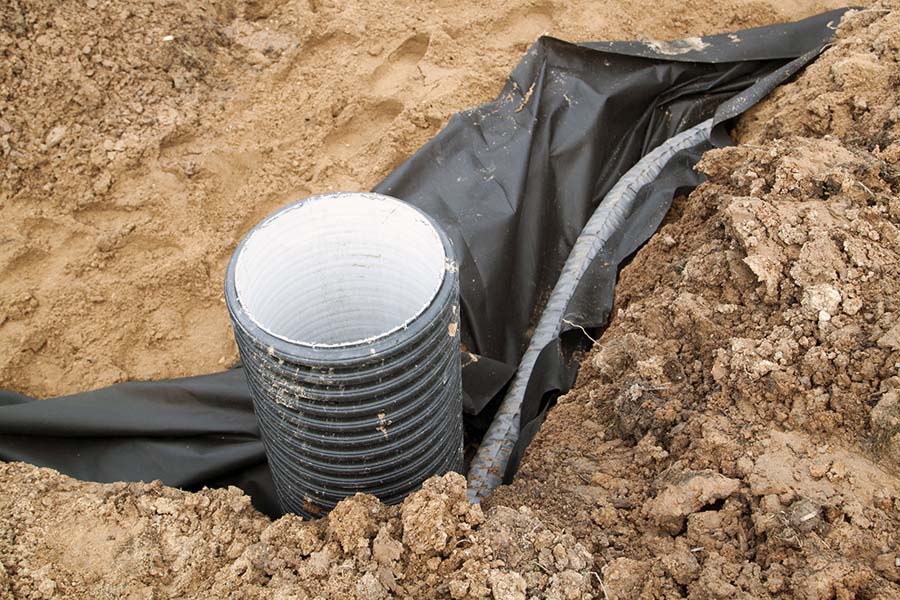
OK. Time for a tricky topic. We’re going to break down one of the highest-stakes callbacks in the business: the flooded basement.
It starts simply: a client pays you to solve a wet yard, you install a French drain, and everything looks great. Two years later, after a heavy spring rain, the drain fails. The client’s basement is flooded, and they are pointing the finger directly at your work.
Yes, it’s a big deal, but this failure is almost always caused by one simple, preventable mistake: clogging. The system gets choked with the very silt and sand it was supposed to drain. The root cause of that clog? Using the wrong tool for the job.
This chapter takes a deep look at filtration, and it’s where we prove our right tool philosophy. That high-strength woven fabric from the last two chapters is the wrong choice in this case, and we’ll explain why a nonwoven felt-like fabric is, really, the only choice for a drain that lasts. We’ll cover the correct burrito wrap method and dig into the engineering of how a filtration fabric works, so you can solve your client’s water problems permanently.
Why Your Stabilizer Fails at Filtration
It’s easy to understand the mistake. You know that a high-strength woven fabric is the tough, professional choice for building stable hardscapes. It feels like the best tool in the truck.
But in a drainage system, that strength is irrelevant, and its low permeability is a fatal flaw. A French drain’s entire purpose is to move water quickly, and a slit-film woven fabric is engineered to do the exact opposite. That means when you wrap a drainage trench in a slit-film woven fabric, you’re building a dam instead of a filter.
Here’s what happens when you use a slit-film: water flows from the soil, carrying fine silt and sand. The water struggles to seep through the tight weave, and silt particles get trapped on the fabric’s surface. Over time, the fine particles accumulate and completely clog the fabric’s pores. This process, known as blinding, essentially seals the drain. Once the fabric is blinded, water can’t get to your pipe. The hydrostatic pressure builds up, and... you’re getting that call about a flooded basement.
Woven fabric is a stabilizer, full stop. Using it here is a classic ‘right tool, wrong job’ failure.
The Filter: Why Nonwovens Succeed
The right tool for this job is a nonwoven geotextile, the go-to product for drainage and filtration. As we covered in Chapter 2, it looks and feels completely different from a woven—it’s that fuzzy, felt-like fabric. In fact, its properties are the exact opposite of a woven fabric, and they’re exactly what you need for a French drain.
How It’s Made (And Why It’s Different)
In a word, there’s no weaving. Nonwovens are made from a random web of synthetic fibers that are bonded together, most commonly by needle-punching, which mechanically tangles the fibers into a thick, three-dimensional mat. This matted, random structure is the secret to its success in drainage.
Key Engineering Properties
- High Permeability (High Flow Rate)
This is a nonwoven’s #1 job. That random, 3D structure creates millions of tiny, easy pathways for water to pass through quickly. It has a high flow rate and won’t dam the water.
- Excellent Filtration
This is the best part. While it lets water flow freely, those same complex, random pathways are fantastic at trapping fine soil particles (silt and sand) so they can’t pass through. Meanwhile, its millions of other interconnected pathways give water easy routes to flow around the captured particles and pass right through. The water continues to flow, and so does your drain.
- Lower Tensile Strength
Here’s the critical trade-off. A nonwoven has no reinforcing grid, so its tensile strength is much lower. It’s a filter, not a stabilizer.
The Burrito Wrap: How to Build a Clog-Free Drain
Since a nonwoven fabric is the only material that provides both high flow and soil filtration, it’s the only professional choice for a French drain or any other sub-surface drainage system. Let’s look at the most common and effective installation method: the burrito wrap. The process is simple and effective:
- Dig your trench.
- Line the entire trench (bottom and sides) with a continuous sheet of nonwoven geotextile, leaving plenty of extra fabric on both sides.
- Add a few inches of clean, crushed stone on top of the fabric.
- Lay your perforated pipe on the stone.
- Fill the rest of the trench with more clean stone.
- Finally, fold the excess fabric flaps over the top of the stone, overlapping them.
This ‘burrito’ completely encapsulates your entire drainage system—both the pipe and the aggregate—in a protective filter. While water can flow in from every direction, silt and soil are stopped at the door. This French drain will run clean and prevent those flooded-basement callbacks for decades.
Putting It All Together: When You Need Both
So, the rule we’ve established is simple, right? Woven for strength, nonwoven for drainage. For 90% of your jobs, like patios and basic drains, that one rule will keep you out of trouble.
But what about those really complex, high-stakes jobs? Take, for example, a tall, engineered retaining wall. That wall is fighting two battles at once: it has to resist the immense pressure of the soil behind it (a stabilization problem), and it also has to safely drain the hydrostatic pressure from groundwater (a filtration problem).
This is where you’ll use both tools. The engineer’s design will often specify a nonwoven filter fabric directly behind the wall blocks to let water escape and prevent clogging. Then, it will also call for layers of a high-strength woven geotextile layered horizontally back into the soil to act as reinforcement, giving the soil mass the tensile strength it needs to hold itself together.
We’ll dig into those specific, high-level applications in the following chapters, but it’s the ultimate example of our core philosophy: no single fabric is “the best.” Instead, the job at hand dictates the best tool (or tools).