It’s Not Just a Weed Barrier
This book doesn’t cover how to stop weeds in a flower bed. Your clients might ask about using “landscape fabric,” but as a professional landscape contractor, you work with geotextiles. And in our world, they’re not weed barriers; they’re an engineering tool.
So let’s not spend valuable time talking about flower beds. We’re going to talk about why a $50,000 paver patio fails in three years—sinking, heaving, and looking like a mess—while another one looks perfect after twenty. The key difference isn’t always the prep work—often, it’s the fabric underneath that prep work.
Let’s talk about that structural, unseen side of the job. This is a no-fluff guide for professionals who want to build hardscapes, driveways, and drainage systems that last—and to stop getting callbacks for failed jobs.
The Language of the Pros: Geotextile vs. Landscape Fabric
Let’s get our terms straight, because in our line of work, words matter. Your client will always call it landscape fabric, and that’s fine. They’re usually just thinking about weeds.
But you’re building a structural system, so you’re thinking, planning, and specifying like an engineer. And engineers call these materials geotextiles. The “geo” part is key—it means these fabrics are designed to work with the earth. (Which might be an interesting point to bring up if your client is suspicious of the new term).
Clearly, professional-grade geotextiles are much more than a simple weed-blocking sheet. They’re specialized materials that perform one of three critical engineering functions. Mastering these functions—knowing exactly which fabric to use for which job—is what separates a pro from an amateur. Get it right, and your projects will last. Get it wrong, and you’re guaranteeing a callback.
The Three Core Functions
Separation
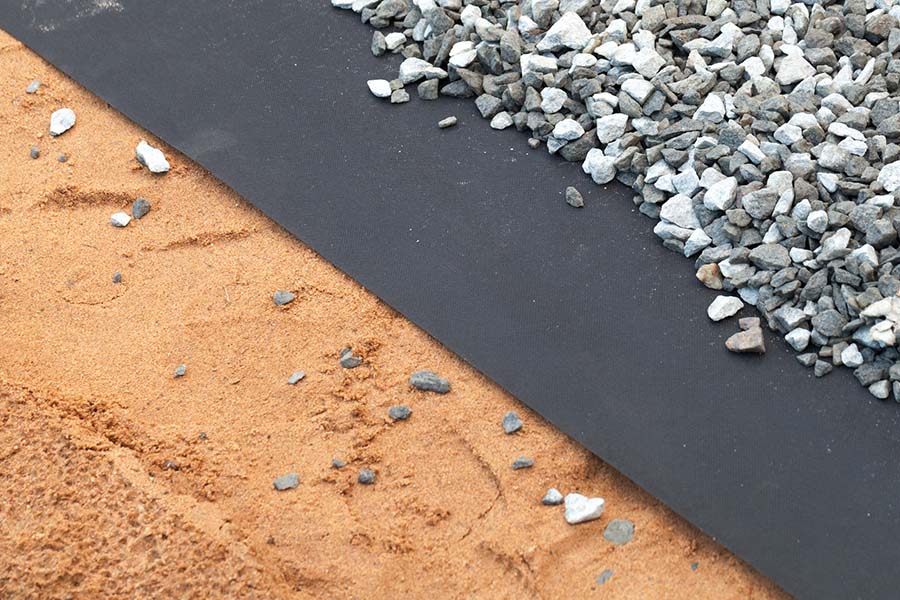
Separation is the most basic job, and it’s remarkably straightforward: you put a geotextile between two different materials you don’t want to mix. The classic example is placing a separator between your expensive, clean aggregate base and the mucky clay subgrade below. The fabric keeps the stone from being pushed down into the mud, and the mud from pumping up into the stone.
Stabilization
This is where things get serious. A stabilization geotextile—almost always a strong, woven fabric—is designed to spread a load. When you drive a truck onto a gravel driveway with a weak subgrade, the fabric takes the pressure from the tires and distributes it over a much wider area. By locking the aggregate in place, it dramatically increases the structural integrity of the entire system.
Filtration
A filtration geotextile—almost always a fuzzy, non-woven fabric—is all about water. It’s designed to let water pass through freely while keeping soil particles where they belong. This is the magic behind a French drain that doesn’t clog. It keeps silt and sand out of your pipe so the system runs clean even decades later.
The #1 rule for a professional landscaping contractor is using the right fabric for the right function. Trying to use a cheap, flimsy weed barrier where you need a woven stabilizer is like using drywall screws to build a deck. It might hold together for a little while, but it’s definitely going to fail.
The Cost of Getting It Wrong: Why “Good Enough” Isn’t
We’ve all seen that guy—the one who tries to save a couple hundred bucks by using a cheap, flimsy weed barrier under a paver patio. (In fact, he’s probably called you a few times!) Obviously, you don’t want to be that guy. In this business, a bad reputation spreads a lot faster than a good one, and callbacks for failed jobs will eat you alive.
All of these expensive, reputation-damaging failures stem from the same root cause: using the wrong (or no) geotextile for the job.
The Sunken Patio
The scenario:
A contractor builds a gorgeous $50,000 paver patio. The lines are perfect, the client is thrilled, and they get paid. A year later, they get the angry call. The patio is a mess. It’s got low spots that hold water, pavers are rocking, and the whole thing has settled unevenly.
What happened?
They built it on clay—ouch! Without a proper separation geotextile, the clean aggregate base and the wet clay subgrade did exactly what they always do: they mixed. The base turned to muck, lost its structural integrity, and the entire patio sank. Now they’re on the hook to rip it all out and do it again, this time for free.
The Rutted Driveway
The scenario:
A contractor installs a new gravel driveway. They dig it out, meticulously lay down a thick layer of crushed stone, and it looks great. Then comes the first wet season. The homeowner’s heavy pickup truck starts leaving ruts. By spring, the driveway is a soupy, rutted mess of mud and stone.
What happened?
Without a stabilization geotextile, the weight of the truck punched the gravel straight down into the soft, saturated subgrade. At the same time, mud pumped up from below, contaminating the clean stone. The driveway didn’t just fail; it was full-out swallowed by the ground it was built on.
The Flooded Basement
The scenario:
Yuck. This is the one that gets lawyers involved. A contractor installs a French drain to solve a homeowner’s wet basement problem. It works great... for two years. Then, after a heavy spring rain, the client’s basement floods, destroying $30,000 worth of new carpet and furniture.
What happened?
They dug a perfect trench and laid a perfect pipe, but they didn’t use a filtration geotextile. Over 24 months, fine silt and sand from the surrounding soil slowly migrated into the drainage gravel, clogging the pipe solid. The drain failed, and the water pressure built up until it found its way into the basement. It’s an entirely preventable failure that just cost that contractor a fortune in liability and reputation.
The “Right Tool for the Job” Philosophy
So, how do you make sure you’re not that guy getting the angry callback? It’s pretty simple: you treat geotextiles like any other professional tool in your truck. You wouldn’t use a drywall screw to frame a deck, and you shouldn’t use a flimsy weed barrier to stabilize a driveway.
This entire guide is built on that simple, “right tool for the job” philosophy. In the world of geotextiles, this boils down to two main families of fabrics: Woven and Nonwoven. They look different, they’re engineered for different jobs, and they are not interchangeable.
Here’s the simple breakdown:
- Woven fabrics are your stabilizers. They are strong and durable, like a heavy-duty tarp, and are built to handle heavy loads and separate materials.
- Nonwoven fabrics are your filters. They are fuzzy, like felt, and are built to let water pass through freely while keeping soil out (think coffee grounds and filters).
In the following chapters, we’ll present a practical, no-fluff playbook on where and how to use each type. We’ll show you why you use woven fabric for stabilizing patios and driveways, and why nonwoven fabric for filtration in French drains and behind retaining walls is an absolute must. We’re not going to push our products for every problem; we’re summarizing the key engineering principles so you’re prepared to build top-notch, durable projects worth staking your reputation on.