

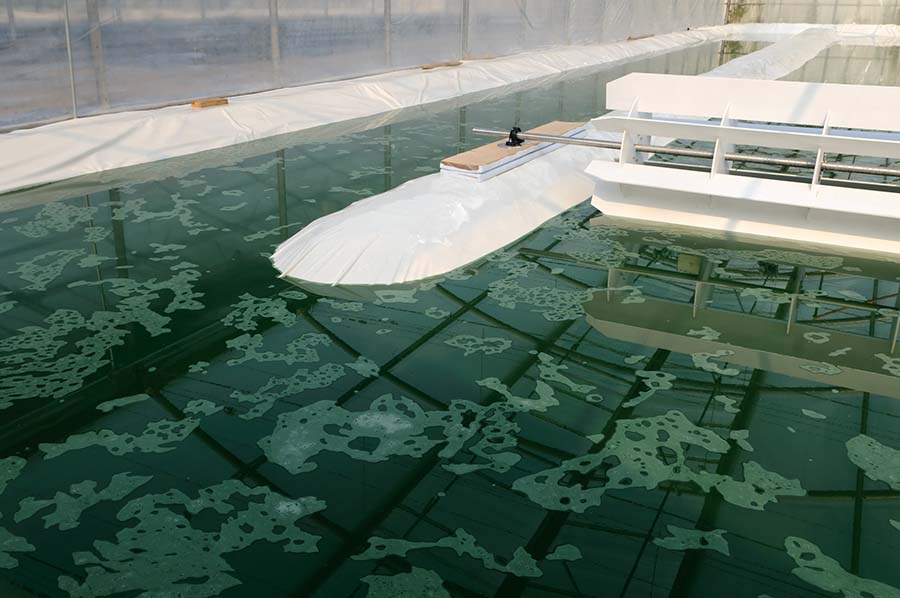
With a site selected and all other systems “go,” it’s time to dig into the details of the business’s physical foundations. For large-scale algae cultivation, that pretty much means an open raceway pond.
While other systems exist, the raceway model offers a widely proven, cost-effective, and scalable solution for commercial production. It’s essentially a closed-loop channel, usually oval-shaped, that continuously circulates the cultivated algae. This simple, highly effective design gives the operator a critical degree of control over the cultivation process.
This chapter breaks down the key engineering elements of an open raceway system. We’ll cover the specifics of the pond’s shape and shallow depth, the paddlewheel system used for mixing, and the liner that contains it all—a component so critical it functions as a technology platform in its own right.
Key Design Elements
The effectiveness of an open raceway pond stems from a few simple yet critical design features that work together to create an optimal growth environment. The primary goal is to keep the entire crop moving and ensure every cell gets its share of sunlight and nutrients.
Shape and Depth
Raceway ponds are designed as a continuous, oval-shaped loop, which improves hydraulic efficiency, allowing water to flow continuously with minimal resistance. With few exceptions, the ponds are characteristically shallow, with operating depths typically ranging from just 6 to 12 inches.
The shallow design is a deliberate choice. It maximizes light penetration through the entire water column, avoiding “dark zones” at the bottom where algae cells would be unable to photosynthesize. While this does increase the land footprint needed for a given volume of water, the increased growth and productivity is a worthwhile trade-off.
The Paddlewheel
To keep the culture circulating, a paddlewheel is placed across the raceway channel. The paddlewheel runs continuously during daylight hours, pushing the water and the algae suspended within it around the raceway at a slow but steady pace.
This constant mixing prevents the algae cells from settling to the bottom, ensures an even distribution of nutrients and CO2, and, most importantly, cycles the cells between the sunlit surface and the shadier depths. This ensures that no part of the crop is starved for light or damaged by excessive exposure to direct sunlight. The energy used by the paddlewheel is a significant operational cost, but it is a non-negotiable requirement for productive cultivation.
Field Notes
As you manage your raceway, keep an eye out for "dead zones"—areas in the U-bends where the water flow slows down, allowing algae to settle and die. You can prevent this by installing simple baffles in the curves of the raceway. These guides help maintain a consistent flow to keep the entire crop productive, but they also save significant energy. Research has shown that well-placed baffles can cut paddlewheel energy consumption by up to 20%—a major reduction in one of your biggest operational costs.
The Liner as a Technology Platform
A high-quality geomembrane liner is the keystone that transforms an ordinary pond into a contained, controlled industrial bioreactor. It provides the clean, isolated environment necessary for commercial success.
Preventing Loss
The most obvious function of a liner is preventing water loss from seepage, which directly saves on water and pumping costs. Just as importantly, it stops expensive, carefully measured nutrients from being lost into the surrounding soil. Liners also prevent product loss during harvest. A smooth liner provides a clean surface to collect settled biomass from, while in an unlined pond, a significant portion of the product—as much as 10-30%—can be lost to the mud.
Keeping the Culture Pure
A liner provides a critical barrier against contamination, stopping naturally occurring minerals, heavy metals, or agricultural runoff in the soil from leaching into the pond and harming the culture. It's also a biosecurity tool, preventing unwanted bacteria, fungi, or competing algae species from invading from the soil. The smooth, non-porous surface is also far easier to clean and disinfect between cycles than a mud bottom, which helps prevent disease from carrying over.
Controlling with Precision
Ultimately, a liner supports the precise operational control that successful commercial production demands. When a liner isolates the water from the soil, the pond’s pH is determined by the algae’s biological processes rather than the chemistry of the underlying soil. This lets operators manage pH effectively with simple CO2 injection. It’s this precise control over the culture’s environment that produces consistent, predictable, and profitable algae cultivation.
Liner Material and Color
Even the choice of liner material and color has implications for pond management.
It’s always critical to use a material that’s certified as safe for its intended use, such as NSF/ANSI-61 for potable water. While many High-Density Polyethylene (HDPE) or Reinforced Polyethylene (RPE) products are certified, not all are. The key, then, is to ensure that the liner from your specific supplier won’t leach plasticizers or other chemicals into the culture. For any operator planning to produce food-grade or nutraceutical products, this choice (and this certification) is non-negotiable.
Liner color is another feature that goes beyond aesthetics. Black liners are the industry standard because they absorb sunlight and can help warm the pond water. This simple passive solar heating can boost growth rates in cooler climates and may extend the growing season.
Still, there are some advantages to aesthetics. Dark liners, for example, hide the inevitable buildup of biofilm on the pond surfaces. Lighter-colored liners do reflect some light, but they are generally avoided because they make every speck of debris highly visible, resulting in a perpetually “dirty” appearance—not a great look for your investors!
Looking Ahead
Once the physical infrastructure has been installed, it’s time to get down to business. The next chapter will examine how a small, pure culture of algae from the lab is scaled up to seed a massive production pond. In this phase, careful technique is everything!

