Storms are coming! Use proven hands-on survival protocols for naturally ventilated livestock barns during heat domes, polar vortexes, and severe storms.
When the Forecast turns Red
So far, we’ve been talking about ventilation in terms of management—optimizing growth rates, keeping bedding dry, and maintaining daily comfort. But a few times a year, ventilation takes center stage in a question of survival.
No matter how temperate your climate claims to be, someday you’re going to face the dreaded heat dome that parks over your region for a week, or a polar vortex that dips down from the Arctic and drops temperatures to -20°F.
Whether extreme weather is commonplace or a shocking anomaly, it will test the limits of your building and your nerves when the margin for error disappears. A mistake in July can suffocate a herd; a mistake in January can freeze your water lines and trigger pneumonia in your stock.
Don’t let yourself get caught wrong-footed. Let’s review some strategies for surviving the slings and arrows nature throws at you.
The Summer Crises: Heat Waves and Heat Domes
The most dangerous weather for livestock isn’t usually a storm; it’s the dead calm of a heatwave. When the temperature climbs above 90°F, and the wind dies completely, the natural wind-driven ventilation you rely on vanishes.
Usually, we can rely on the stack effect—hot air rising from the ridge and pulling in fresh air through the sides—to keep air moving. But this effect hinges on temperature differences. In the middle of a heatwave, when it’s 95°F inside and 95°F outside, the temperature difference disappears, the thermal engine stalls, and the air stops moving.
But your livestock continue to generate massive amounts of internal heat, and if they can’t shed it because the air around them is saturated and still, they stop eating, their immune systems crash, and, in severe cases, they die of heat stroke. In these conditions, you need to focus on removing every obstacle between your animals and the outside air. Here’s your plan of action:
The Open Wall Protocol
- Drop Curtains 100%: Don’t leave them halfway up in an effort to keep the sun out. If you have overhangs, they should shade the opening somewhat, but even if they don’t, the airflow is still worth the solar gain. You need the sidewalls completely gone so even the slightest thermal drift can move air across the animals.
- Supplement Natural Air Movement: If you have stirring fans or circulation fans, turn them to maximum. Natural ventilation doesn’t work in a dead calm, so you need to introduce some velocity to keep the animals’ evaporative cooling strategies (sweating or panting) effective.
The Winter Crises: Polar Vortex and Deep Freeze
When winter hits hard, every instinct you have as a mammal says, “shut the door, close the windows.” You want to button that barn up tight to conserve heat. Don’t do it.
Sealing the barn is the most common mistake in winter ventilation. Yes, it conserves heat, but it also traps moisture from manure and respiration. The relative humidity quickly hits 100%, condensation drips from the ceiling, and the air is thick with ammonia. Respiratory disease follows quickly.
Your plan of action needs to focus on a single golden rule: Fresh air is more important than heat. After all, you can fix a cold barn with extra bedding and feed, but you can’t fix a wet barn with anything. This means, regardless of the outdoor temperature (yes, even at 10 below), you must maintain a minimum vent opening.
The Minimum Ventilation Protocol
- Crack the Leeward Side: Keep a small opening (1–2 inches) on the side away from the wind. This avoids blowing a direct freezing draft on the animals while giving stale, moist air an escape route.
- Watch the Water Lines: This is the balancing act—achieving ventilation without freezing your plumbing. If freezing pipes are a major concern, focus instead on controlling the air-exchange rate.
- The Timer Trick: Instead of leaving a permanent crack, some farmers use a timer to open the curtain for 5 minutes every hour to flush the air, then close it again to recover heat. (Obviously, this works best if you have motorized curtains.)
The Kinetic Crises: Severe Storms, High Wind, & Hail
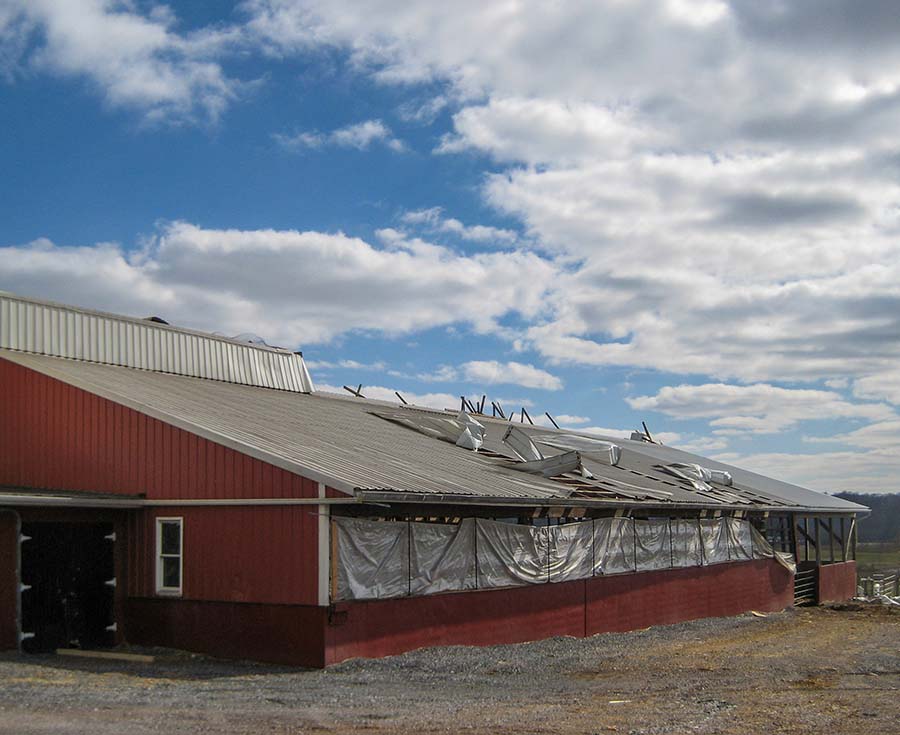
Sometimes the weather threat doesn’t involve temperature at all. Severe thunderstorms and their occasional companions (tornadoes, squalls, derechos) bring erratic, violent winds that can down power lines and pull siding off a house. In your barn, when strong winds get behind a loose curtain, the intense pull can rip the fabric out of the track, bend the drive pipe, or even tear the curtain material to shreds—the embodiment of “three sheets to the wind.”
The High Wind Lockdown
As soon as a severe thunderstorm warning is issued, it’s time to focus on structural preservation.
- Check your Anti-Billow Ropes: Before the storm hits, walk your barn’s perimeter. If you can easily pull a rope away from the curtain wall with two fingers, it’s too loose. Crank the ratchet straps down a notch to ensure the web is tight. Loose ropes allow the curtain to “chatter” (bang back and forth), which weakens the fabric.
- Fully Open or Fully Closed: Never leave a curtain partially open during a high-wind event—that curtain hanging at 50% is a kite waiting to fly. It catches the wind but lacks the tension to resist it.
Fully Closed is the standard protection mode. The curtain is pulled tight against the bottom sill and pressed firmly against the anti-billow ropes. In rare cases (such as summer squalls when heat is still a danger), you may choose to leave your curtain fully open. Bundle it tightly at the top or bottom so the wind can pass through the building without grabbing the fabric.
Closing the Barn (Thinking Ahead)
The most confusing advice in storm prep is whether to open the barn up or button it down tight. (Remember the confusion about whether to open your house windows when a tornado is coming?)
Well, in the case of your barn, the answer depends on your structure, specifically, how your roof is attached.
You see, most barns don’t blow over in a tornado or hurricane; they blow up. If strong wind breaches your windward wall (or if you leave the windward curtain open) but the rest of the barn is sealed tight, the wind rushes in and has nowhere to go. This spikes internal pressure and pushes up on the roof, while wind passing overhead creates suction. If that upward force exceeds the strength of your nails, the roof peels off like the lid of a tin can. We’ve all seen plenty of those pictures.
The Pre-Season Audit: Since recently installed manufactured barns are a relatively rare breed, you probably don’t have a manufacturer to call for advice. In this case, you’ll need to assess your own uplift resistance well before storm season starts. It’s relatively simple: grab a ladder and look at where your trusses meet the posts.
The Toenail Problem: In many older barns, roof trusses are simply toenailed (nailed at an angle) into the top plate. This is a weak connection that relies mainly on gravity, leaving your roof vulnerable to being ripped right off if a curtain blows out on the windward side. Some farmers in this situation choose to open both sides slightly (equalizing pressure) to allow wind to pass through. However, this does expose the animals to the elements, including whatever debris the wind may carry.
The good news is that the fix (hurricane ties) is relatively simple: Buy a box of metal hurricane ties (truss anchors) and install them before the first storms of the season arrive. These metal straps wrap around the truss and screw into the post, mechanically locking the roof to the walls. With the roof safely secured from taking flight, you’ll be more confident in buttoning down the barn.
If your audit reveals the structure is strong (Hurricane ties, solid posts), you can confidently seal the barn tight during violent storms. The hurricane straps will hold the roof down against the internal pressure, and the sealed building will keep the animals dry and safe.