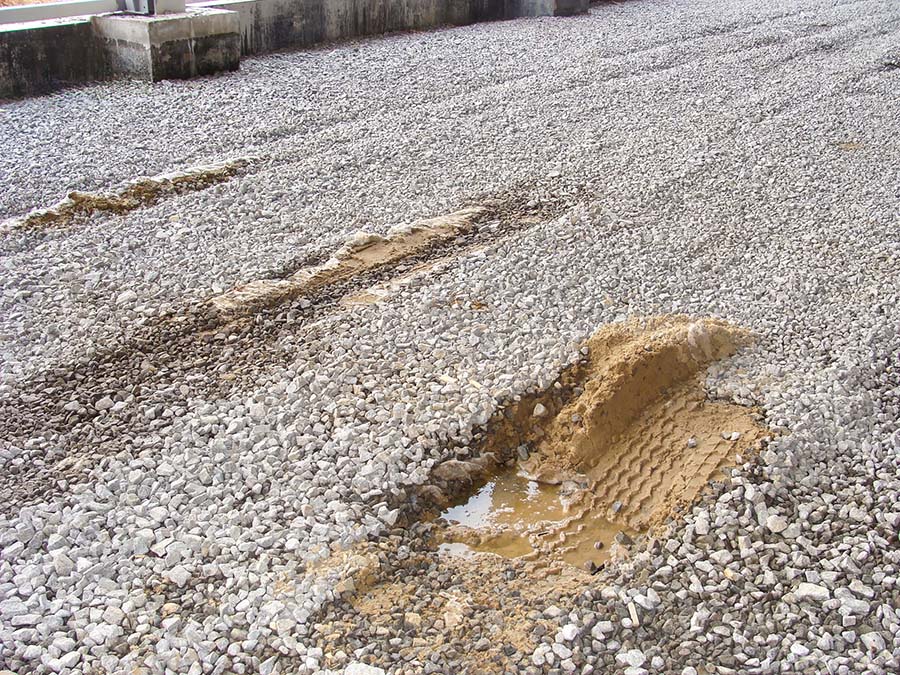
A brand-new gravel driveway looks great—right up until the first heavy rain and the first pass with a loaded pickup truck. Then, the all-too-common callback comes in: the driveway is a rutted, soupy mess of mud and stone.
We already know this comes from a failure of separation. But for a driveway, the problem is much bigger than a patio. Rather than managing a few hundred pounds of foot traffic, you’re dealing with the dynamic, high-impact load of a 6,000-pound truck. This is exactly where stabilization becomes your primary concern.
Putting a thick layer of expensive, good-looking crushed stone directly on a soft soil subgrade is a great way to feed a lot of gravel to the mud. The focused weight of the tires punches that stone straight down into the wet, soft soil. At the same time, the pressure forces mucky soil particles up into the aggregate, contaminating your base. The driveway loses all its structural integrity and is swallowed by the ground it was built on.
The answer to this problem is to engineer a system that actively stabilizes, not just separates. In the following sections, we'll break down exactly how the right geotextile solves this and lets you build a rock-solid surface that can take a beating for years.
How a Woven Geotextile Delivers a Rut-Free Driveway
For this job, the right geotextile is a slit-film woven geotextile because it provides three critical functions at once: separation, stabilization, and permeability. A material that misses any one of these functions will inevitably fail.
Separation: Keeping the Layers Clean
First, the basics. Just like with a patio, the slit-film woven fabric establishes a physical barrier between your two problem layers. It stops the pumping action, preventing mucky clay from migrating up and contaminating your expensive stone base. It also stops the sinking action, keeping the aggregate from being punched down (and consumed by) the soft subgrade.
Stabilization: The Rebar for Your Road
This is the real magic. Stabilization is how the fabric actively adds structural strength to your driveway. In chapter 2, we saw that a slit-film woven fabric has two key properties: high tensile strength and low elongation (it doesn’t stretch). So when you place this fabric over a soft subgrade and a 6,000-pound truck drives on it, the woven fabric immediately goes into tension, acting kind of like a snowshoe. It accepts the focused load and spreads it over a much wider area of the subgrade. By distributing the load, the geotextile prevents the underlying soil from shifting or compacting and prevents gravel from punching through. This is the key to stopping ruts before they even form.
Permeability: Preventing the Bathtub
This is the critical function that a simple impermeable geomembrane gets disastrously wrong. A driveway is not a pond; it must drain. The slit-film woven fabric, with its controlled but measurable permeability, allows rainwater to pass through your aggregate base and drain slowly into the subgrade below.
An impermeable liner traps that water. This creates a bathtub effect, turning your base into a soupy, unstable mess. To make matters worse, in cold climates, this trapped water freezes, expands, and causes frost heave that will destroy the driveway in a single season.
A slit-film woven geotextile is the only tool that provides the high tensile strength needed for stabilization and the permeability required to prevent the system from saturating and failing.
Hood of the Truck Engineering: Building on Bad Soil (Low CBR)
In the field, you’ll hear geotechnical engineers talk about the California Bearing Ratio (CBR). In simple terms, this is a score for your subgrade’s strength. A high CBR is solid ground; a low CBR (common in wet, mucky clay) has almost no load-bearing capacity.
Here’s where the magic happens: a woven geotextile can bridge over these low-CBR soils to create a stable platform for your aggregate. It allows you to build a rock-solid driveway on mucky ground that would otherwise be a costly, unstable nightmare.
The Payoff: Build a Better Driveway with Less Gravel
Here’s the part that directly impacts your bottom line:
Without a geotextile, the only way to build a stable driveway on bad soil is to keep dumping expensive crushed stone. You might have to excavate 18 inches of muck and replace it all with aggregate just to get a firm base. (But that soil down at the bottom is still going to get hungry.)
With a high-strength woven geotextile, you have a fully engineered system that provides all three critical functions. The fabric’s high tensile strength provides the stabilization, allowing you to achieve the same load-bearing capacity with a much thinner aggregate layer—often 30% to 50% less. Just as importantly, its separation function keeps that thinner layer clean, and its permeability ensures the entire system drains properly, preventing the bathtub failures we discussed.
And that’s the secret: with a slit-film woven geomembrane, you’re building a stronger, longer-lasting, callback-proof driveway while saving a massive amount on material, hauling, and labor costs.