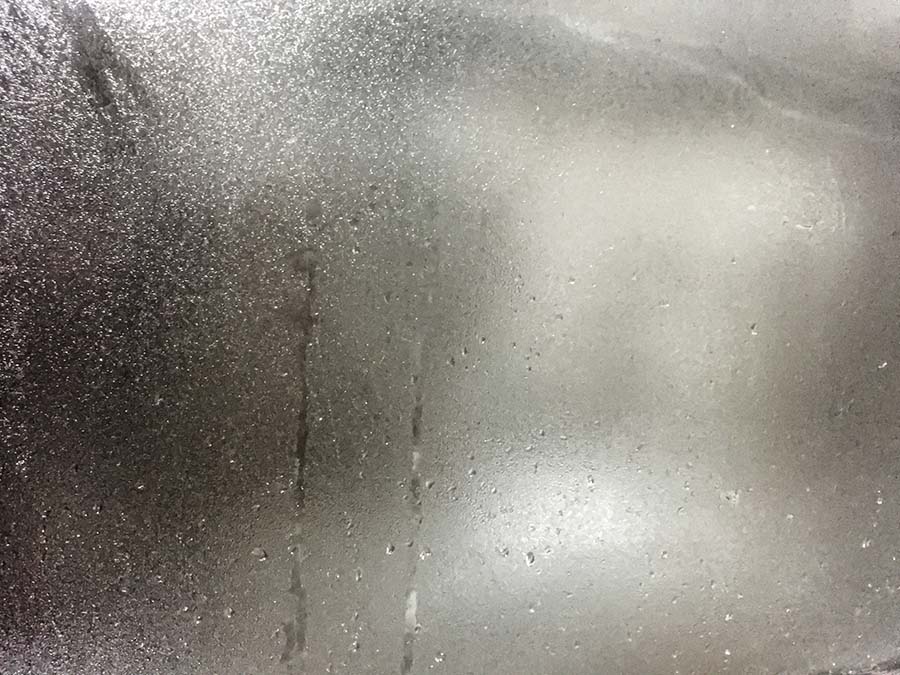
It’s been a beautiful week, and today just tops it off with the perfect winter morning. The sun is out, the air is crisp, the ground is bone-dry, and you actually kicked your feet out for an extra five minutes to enjoy your coffee on the porch. But when you step into the barn, straight into a puddle, the vibe changes instantly. You check the bedding in the pens—damp. You glance up to the ceiling, and splat—a cold drop of water hits you squarely on your cheek. Ugh!
It’s the ultimate irony: the weather outside is gorgeous, but it’s raining indoors. Why? It all comes down to atmospheric science - and in this case, it’s the atmosphere inside your barn.
Like most modern barns, yours is lined with a polyethylene vapor barrier—a plastic sheet stapled to the trusses to protect the wood from rot. Essentially, the inside of your barn is just one giant plastic bag, and that’s where your animals live. It’s flexible, affordable, and effective.
As animals tend to do, your livestock generates massive amounts of heat and moisture. When warm, humid air rises and hits a cold plastic ceiling (or your single-layer sidewall curtain), it cools instantly, loses its ability to hold moisture, and dumps it as liquid water. On standard plastic, that water beads up, gets heavy, and falls. And while a wet floor (or occasional face drip) is merely annoying for you, it can be deadly for your animals.
The Cold Drop of Death
In the industry, we often talk about air quality but rarely about indoor rain. We need to, because a single drop of cold water falling 10 feet can be deadly.
Thermal Shock
Consider a day-old chick or a neonate piglet. They are operating on a razor-thin energy margin. They need every calorie they consume to go toward growth and immune system development. But when a cold drop of condensate hits that animal, it soaks their fur or down, and as we know, wet insulation has zero R-value.
So what happens? The animal immediately stops growing and starts shivering just to stay warm. You aren’t feeding it for weight gain anymore, you’re feeding it just to keep that internal furnace running.
The Pathogen Delivery System
As if that wasn’t bad enough, that drop of water wasn’t sterile. Instead of falling directly from a (relatively) pure cloud, it condensed on the surface of a dusty barn wall, and as it formed, it captured dust, mold spores, and airborne bacteria floating near the ceiling.
Whether you grew up with comic books or big-screen blockbusters, it’s easy to visualize that bead of water as a concentrated delivery system, dropping a payload of pathogens directly into the feed bunk, the water line, or right onto the animal’s snout. (So much for all your painstaking biosecurity protocols.)
The Science of Surface Tension (Beading vs. Sheeting)
So, how do we stop the rain?
First, you have to accept that you can’t eliminate condensation. As long as you have warm animals inside and cold winter air outside, physics dictates that water will condense on your curtains. So don’t bother trying to stop the water from forming; your strategy is to stop it from falling. And to do that, we need to change the surface tension.
The Problem: Hydrophobic Plastic (Beading)
Standard polyethylene is naturally hydrophobic—it really doesn’t like water—so when moisture hits the surface, the plastic repels it. Since the water molecules have nowhere to go, they cling to each other, forming round, heavy beads. As the beads grow, gravity eventually wins: the surface tension breaks, and splat—the drop falls.
But don’t forget this fun little “bonus”: the fog effect. Before falling, those millions of tiny beads turn your clear curtain into something resembling a frosted glass window. They refract and scatter the sunlight, turning your clear curtain milky, and blocking the solar energy you fought for in Chapter 1.
The Solution: Hydrophilic Technology (Sheeting)
This is where material science solves the physics problem. High-quality agricultural curtains (like ArmorClear) are treated with anti-condensate additives. These chemicals make the surface hydrophilic—in other words, they make the plastic “love” water—so instead of bunching up into heavy beads, the water molecules are attracted to the surface, and they spread out instantly into a flat, microscopic film.
Because the water is spread out, it never gets heavy enough to fall. Instead, it adheres to the slope of the curtain and slides harmlessly down the sidewall to the ground/drain. Nice, eh? We call this “sheeting.” Because the water forms a transparent film rather than beading up, your barn stays bright, your bedding stays dry, and your animals stay warm.
The Verdict: The High Cost of “Indoor Rain”
It is easy to dismiss a few drips as a minor annoyance. But when you look at the aggregate cost of indoor rain, the math gets ugly fast.
Here’s a startling thought: anti-condensate technology isn’t just a plastic coating; it is your new secret weapon for farm efficiency.
The Biological Cost
Every drop that hits your animals forces them to burn expensive feed just to stay warm. You’re paying for growth, but you’re only getting body heat.
The Environmental Cost
Every drop of water that hits the floor accelerates ammonia production. That forces you to run fans longer (burning electricity), and crank the heater higher (burning propane).
The Labor Cost
Every wet spot becomes a chore. Instead of managing your operation, you’re spending hours shoveling out wet litter and adding fresh bedding just to keep pathogens at bay.
It’s a rare investment that lowers your heating bill, your feed bill, and your labor costs—simultaneously.