

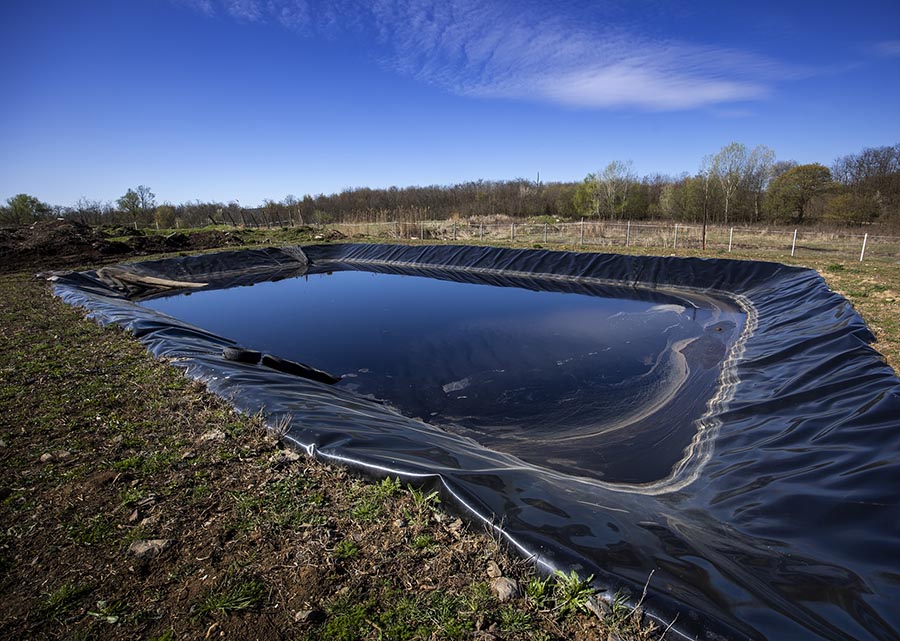
While natural-bottom or concrete ponds have their place, a pond built with a high-quality geomembrane liner offers distinct and powerful advantages for anyone keeping fish through a harsh winter. The liner provides a level of control and security that is difficult to achieve with other methods.
The Advantages of a Lined Pond in Cold Climates
Absolute Water Containment
A slow, undetected leak in the summer can be an annoyance. In winter, that same slow leak under a sheet of ice can be a silent catastrophe, gradually draining the deep-water sanctuary your fish depend on. A properly installed, high-quality liner is completely impermeable, giving you the peace of mind that the water volume you have in the fall is the same as the water volume you’ll have in the spring.
Design Flexibility
As we’ve discussed, specific design features—like deep basins, steep sides, and plant ledges—are critical for overwintering success. Natural clay soils can limit the shapes and depths you can achieve, and concrete is both expensive and unforgiving. A flexible liner gives you the freedom to create the custom shape and depth profile your fish need to thrive.
Durability Against Frost Heave
The ground in cold climates freezes and thaws repeatedly, causing it to expand and contract with immense force. This “frost heave” can easily crack rigid structures like concrete and mortar. Modern, high-quality liners like EPDM and RPE are flexible enough to stretch and shift with the ground without cracking or failing. This is a huge benefit for the pond you’re investing so much time and energy in.
Material Deep Dive: EPDM (Ethylene Propylene Diene Monomer)
EPDM is a high-quality synthetic rubber that feels very similar to a heavy-duty inner tube. For decades, it’s been a reliable industry standard for backyard fish ponds, and its properties are uniquely suited to the demands of a cold climate.
EPDM’s Advantages in Winter Ponds
Unmatched Flexibility for Frost Heave
EPDM’s most significant advantage for a winter pond is its ability to withstand the immense pressures of frost heave. Since it remains flexible even in freezing temperatures, it can stretch and relax repeatedly as the ground shifts through repeated freeze/thaw cycles. This remarkable flexibility virtually eliminates the risk of cracks and failures associated with cold climates.
Durability and the Crucial Role of Underlayment
While EPDM is an extremely tough and puncture-resistant material, this durability is only effective when the liner is protected from punctures. Even in a well-prepared subgrade, repeated or prolonged frost heaves can dislodge sharp rocks from the sides and bottom of the excavation, causing them to press directly against the liner. For this reason, a high-quality geotextile underlayment is a non-negotiable part of any EPDM installation. A thick, nonwoven fabric is installed between the excavated soil and the liner, protecting it from sharp rocks or roots that could appear, courtesy of your cold climate.
Cold-Weather Workability
Pond construction often happens in the fall as temperatures are dropping. EPDM’s ability to stay soft and flexible even in cold weather makes it far easier and safer to install than more rigid liners, which can become stiff and difficult to position without causing damage.
Considerations for Cold Climates
Weight
There’s no way of getting around it: EPDM is heavy. Maneuvering a large, heavy panel can be even more challenging in cold, wet fall weather and often requires help from one or more people. For larger ponds, power equipment is usually necessary.
Cold-Weather Seaming
The primers and seam tapes used to join two pieces of EPDM have minimum temperature requirements for proper curing. Creating a reliable, waterproof seam in the cold temperatures of late fall can be difficult, reinforcing the benefit of using a single sheet whenever possible.
The Bottom Line
EPDM’s exceptional cold-weather flexibility makes it a forgiving and time-tested choice for any pond that must endure the physical stresses of freezing and thawing ground.
Material Deep Dive: RPE (Reinforced Polyethylene)
A newer (but well-established) player in the pond liner market, RPE has become the material of choice for projects where strength and durability are the top priorities. Unlike the synthetic rubber of EPDM, RPE is a woven, fabric-like material. It is constructed with a high-tensile polyethylene weave (scrim), which is then coated on both sides with layers of polyethylene. This reinforcement gives it significant advantages.
The Pros of RPE
Exceptional Strength
This is RPE’s primary advantage. The internal woven scrim gives it incredible tensile strength and puncture resistance, far exceeding that of non-reinforced liners like EPDM. It is highly resistant to tears and punctures.
Lightweight and Easy to Handle
Despite its strength and durability, RPE is significantly thinner and lighter than EPDM. This makes it much easier to ship, move around the job site, and install, especially for very large ponds where an EPDM panel of the same size would be extremely cumbersome and difficult to deploy.
Custom Fabrication
RPE’s composition makes it ideal for being thermally welded in a factory into large, custom-fabricated, three-dimensional panels. This can eliminate the need for difficult on-site seaming for large or complex projects.
Considerations for Cold Climates
Less Flexible
This is the main trade-off. RPE is stiffer and less pliable than EPDM. It doesn’t drape as easily and can be more challenging to fold neatly into tight corners or around small, intricate shelves. It behaves more like a thick, foldable tarp than a soft rubber sheet.
Underlayment is Recommended
Just like EPDM, the long-term durability of RPE depends on how well it’s protected from the substrate. While excellent subgrade preparation is acceptable in most installations, a high-quality geotextile underlayment is recommended for RPE installations in cold regions where frost heave is a consideration.
A Note on HDPE (High-Density Polyethylene)
HDPE is an extremely tough, dense, but relatively inflexible plastic liner known for its durability and chemical resistance. Once a popular and inexpensive choice for pond liners, nowadays it’s more often used for industrial applications, such as landfill liners, mining leach pads, and large-scale water reservoirs.
HDPE has been outshone as a pond liner primarily because better, more cost-effective options have appeared. HDPE’s density and inflexibility make it expensive to ship and difficult to fold or conform to the curves and contours of a typical fish pond without damage. Furthermore, it can only be seamed on-site by technicians trained on specialized thermal welding equipment, making it a non-DIY product.
Pro Tip: Beat the Clock on Cold-Weather Installation
Whether you’re joining two large liner panels, sealing a bottom drain, or attaching a skimmer, the products that create permanent, waterproof seals are almost always temperature-sensitive. In fact, primers, seam tapes, sealants, and even thermal welds all require a minimum ambient temperature (typically above 40°F) and dry conditions to cure and bond properly. Working in cold or wet weather can result in weak seams and failed gaskets—the exact kinds of hidden leaks that can become a catastrophe during the winter.
The takeaway? Plan your project schedule carefully. All the critical “waterproofing” work on your pond should be completed during the warmer, more predictable weather of late summer or early fall. Don’t leave essential seals to the vagaries of weather.

