

Congratulations! You now have 50,000 young adult crickets! Give yourself a pat on the back and take a deep breath, because your success means you’ve now advanced to a new challenge: how to manage all that product!
Harvesting a few bins by hand is therapeutic. You can take your time, shake a bucket, and admire your work. But with 50 or 100 bins, that therapeutic interlude becomes a labor crisis. With manual methods, your harvest day will become a 14-hour slog, and your hourly income will drop to pennies. If your scale-up to commercial level is to be successful, this is where you need to transition from manual to mechanical methods.
The Separation Bottleneck
Your first challenge is volume. For every pound of insects you harvest, you’re also dealing with pounds of frass (waste), shed skins, and leftover grain. Your customer pays for clean bugs, not the other stuff.
As a hobbyist, your limit for hand-sifting was probably about 15 lbs of material per hour. That’s fine for a garage setup, but it’s a big problem for an expanding business. To run a profitable farm, you’ll need to process closer to 200 lbs per hour, and the only way to bridge that gap is to stop shaking buckets.
The Rotary Trommel
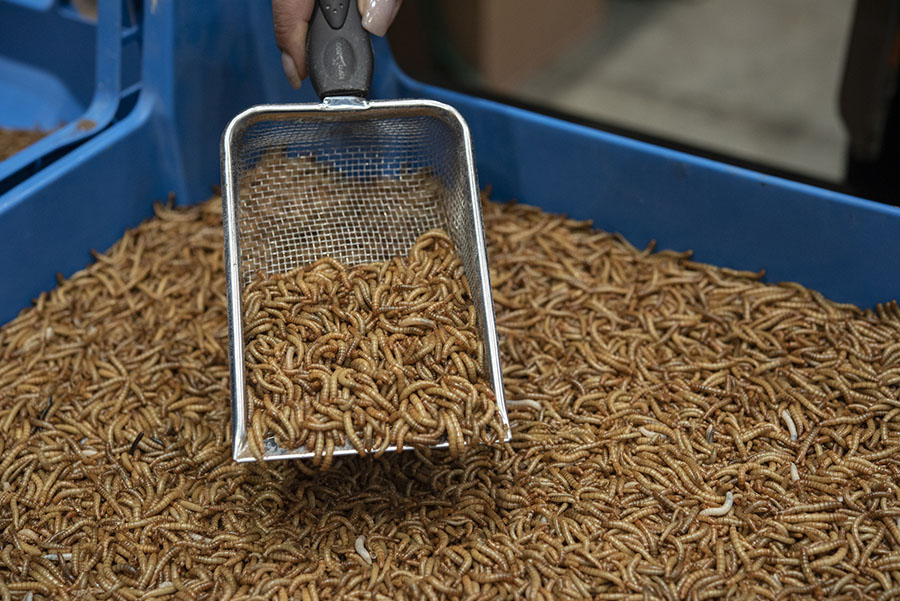
For separating dry species like crickets and mealworms, the industry standard is the Rotary Trommel. Its claim to efficiency is based on its straightforward, continuous-flow design. Empty a full bin into the hopper of a rotating cylinder, and as the screen spins, the heavy frass falls through the mesh while the clean insects tumble gently out the end. A single person continuously feeding bins into a trommel can turn a full-day job into a very manageable 60-minute task.
The BSF Exception
If you’re farming Black Soldier Fly (BSF) larvae, however, a trommel is worse than useless. BSF larvae are wet, and their substrate is often damp. If you try to sift them, you’ll end up with paste.
Since BSF larvae don’t mix well with machinery, you get to scale operations with magic! (err...biology).
BSF larvae develop a powerful climbing instinct right before they pupate—instinctively seeking high, dry ground. By installing bins with a 35-degree ramp leading to a drop-off hole, your maturing larvae will harvest themselves. Following an irresistible call, they’ll climb the ramp, fall into your collection bucket, and leave the wet substrate behind. It is the only zero-labor harvest method in the industry, and it relies entirely on bin design.
The Purge: Value & Hygiene
Cleaning the Guts
Newly harvested insects look pretty clean, but their guts are full of frass and half-digested grain. This is your chance to move your product up a notch with either a cleanse or a purge. Whichever you choose, it comes in the first 24-48 hours after separation. If you’d rather just get your product on the shelf, you can skip straight to packaging.
The Cleanse (Hygiene Focus)
If your priority is shelf life or minimizing spoilage (especially for frozen/dried products), you want the insects’ guts emptied out. All you need to do is place them in a clean bin with hydration (water gel) but no food for 24–48 hours. This gives them time to completely evacuate their digestive tracts. An empty gut means fewer bacteria, less risk of internal rotting during storage, and a cleaner taste.
The Gut Load (Value Focus)
On the other hand, if your priority is premium pricing (especially for the live reptile market), you want the insects full, but full of the right stuff. Immediately after harvesting, swap standard grain feed for nutrient-dense options like carrots, leafy greens, or high-calcium chow. After 24 hours, you’ve replaced the cheap grain in their gut with vitamins. This is no longer just a bug—you’re now selling a complete vitamin delivery system. This is a huge differentiator in the reptile market.
The Fork in the Road
Once your insects are prepped, it’s time to choose your path. Will you sell them wiggling, or will you preserve them?
The Live Trade: High Margin, Logistics Heavy
Live insects command the highest price per pound, but selling this product means you’re adding another hat: logistics manager, because it all boils down to two ways to move live product:
The Shipping Game (National Reach)
When you’re selling on the national market, you pack your boxes and hand them over to FedEx/UPS. Seems simple and easy. However, you’re constantly fighting the clock and the weather. If a shipment sits on a hot truck for 2 hours, you’ll lose the product (and possibly the customer). No matter how carefully you plan, you’ll be constantly monitoring national weather patterns, buying heat packs/cold packs, and handling the occasional Dead on Arrival (DOA) refunds.
The Milk Run (Local Delivery)
If your customers are local, life is simpler: you load the van and deliver directly to local pet stores, zoos, universities, or bait shops. The benefits are profound: zero packaging cost (you can swap reusable bins) and 100% survival rate. However, you’ve now become a delivery driver. This might work well for your first 100 miles, but it won’t scale without hiring a driver.
The Preserved Market (Stability)
Focusing on shelf-stable insects (frozen for reptiles, or dried for chickens/wild birds) offers one huge benefit: inventory control. You can harvest 500 lbs today and sell them next month (or the month after) because it separates your production schedule from your sales schedule. However, you’ll be competing with large commercial farms that operate on thin margins, and that will drive your price per pound down.
The Verdict
Most successful businesses begin with Local Live Delivery (low risk/high cash flow), expand to Shipping (increased volume), and use Preserved Products to manage surplus.
Packaging Protocols
Packing Live
You probably know this by now, but you can’t just dump 1,000 insects into a box. They’ll pile up, overheat, and suffocate or cook the ones at the bottom during transit. It’ll be a whole mess.
Crickets (Fragile)
Crickets need personal space. Fill your shipping box with harborages—standard egg flats or cardboard spacers—so they don’t crush each other. Include a moisture source, such as a few potato chunks or a commercial gel pack, and make sure the box has a few screened vents so they can survive 2-3 days in transit.
Mealworms & BSF (The Tough Guys)
These guys are durable but prone to overheating. You can ship them in breathable cotton bags, like flour sacks, or in vented plastic cups. Add a handful of bran or sawdust to absorb moisture and keep them from clumping into a heat ball. For the standard 2-3 days shipping time, they don’t need extra moisture. In fact, adding it can cause mold or rot in the bag.
Packing Frozen
First, you can’t just throw a bag of live bugs into a deep chest freezer. Insects insulate each other—if you freeze a bag with a mound of insects, the ones in the middle will stay alive for hours, stressing and ruining the meat quality.
Since farmers in the process of scaling up don’t have access to an industrial blast freezer, you can use the tray method to get similar results.
Start by spreading your insects in a single layer on baking sheets. By maximizing surface area, the cold will penetrate immediately on all sides, freezing the insects solid in under 60 minutes. This prevents large ice crystals from forming, so they aren’t mushy when the customer thaws them.
Once they’re all frozen solid, pour them from the trays into bulk bags or vacuum seal them for long-term storage.
Packing Dried
Drying your product allows you to store inventory for months, but moisture is your enemy. If you leave even 15% moisture in the insect, two weeks later, you’re going to have a bag of mold.
OK. Let’s start with a clear message: Never put live insects directly into a dehydrator. It’s cruel and messy. You need to dispatch them first—either by freezing (see above) or boiling (blanching) for 2 minutes.
Blanching is the preferred method for Mealworms and BSF. It sterilizes their shell, stops them from turning black, and helps them keep their shape.
- Once they’re dispatched, place your insects on dehydrator trays and follow the instructions. You’re aiming for a moisture content below 5-10%.
- How do you know if they’re ready? Take an insect and bend it. Crickets and mealworms should snap cleanly in half. If they feel leathery or bend, they need more time in the dehydrator.
- Black Soldier Flies (BSF) are high-fat. They might feel oily to the touch, but they should still be brittle enough to crush. If they’re rubbery, they’re not done.
After your insects have cooled down, weigh them and pack them in airtight bags (Mylar is best). Don’t forget to include a desiccant pack (silica gel) in every bag to absorb residual moisture and prevent spoilage.

