Driving down any rural county road, it’s easy to spot small-scale livestock operations by those distinct blue patches on the buildings. They’re “standard blue tarps,” those ubiquitous polyethylene sheets strapped to the sides of a hoop house or a retrofit barn.
It’s easy to understand why these are the default. Blue tarps are cheap, they’re available at the hardware store, and they stop the wind. If all you expect from your sidewall curtains is to open and close them, those cheap blue tarps technically do the job just fine.
But is that really the best you can do for your animals?
For the small-scale farmer—who likely isn’t running a million-dollar, fully automated tunnel-ventilation system—the sidewall curtain is your primary climate control mechanism. It regulates airflow and manages humidity and temperature. But despite their importance, too many producers treat their sidewalls as an afterthought. They nail up an opaque sheet of heavy vinyl or cheap poly, and think no more about it. Meanwhile, they’ve effectively turned their barn into a dungeon.
Light: The Forgotten Nutrient
Yes, plastic sheets block the wind. But they also block the sun (their one free resource), which directly impacts the health and growth of their stock.
Farmers of all sizes obsess over feed formulations. We calculate protein percentages and weigh micronutrients down to the gram. But how often do we ignore the significant biological impact of natural light?
The Poultry Photoperiod
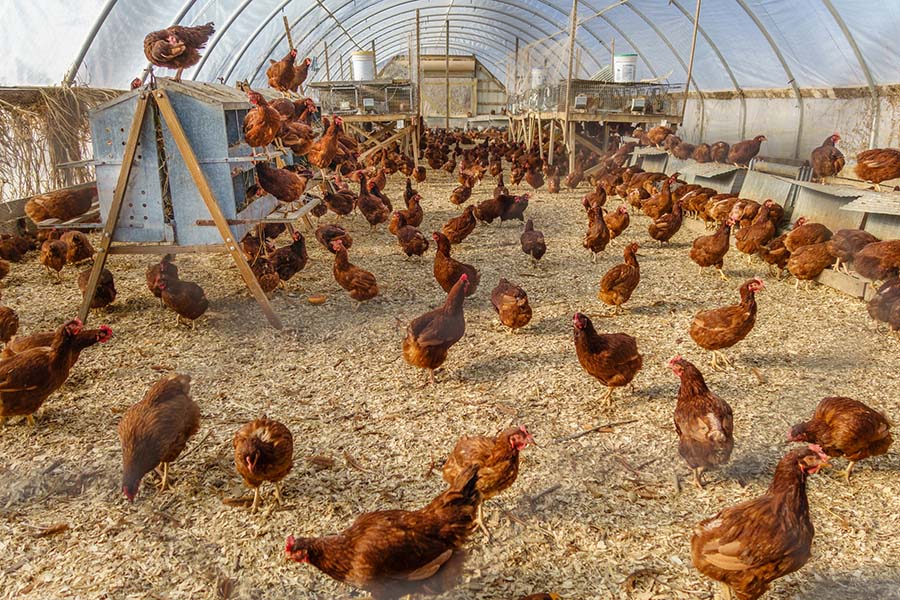
If you are raising layers, you know that light is the trigger for egg production. A hen’s reproductive cycle is governed by the length of the day. In a “dungeon” barn with solid vinyl sidewalls, you’re setting yourself up for a constant battle with nature. You have to blast high-lumen bulbs to simulate a day cycle, and even then, the spectrum is limited.
The Swine Circadian Rhythm
While they don’t need light for egg production, hogs are just as sensitive to their environment. Pigs raised in dark or artificially lit environments tend to be more stressed and aggressive than those raised in naturally lit barns. And we don’t need any reminders that stressed, aggressive pigs aren’t the best producers.
So when you install opaque, blackout-style curtains on a barn, you’re severing the connection between your animals and the natural world, and you’re forced to rely entirely on artificial lighting to maintain the photoperiods necessary for healthy growth and production. It’s a one-two punch: you’re adding to your electrical bill and subtracting from your farm’s productivity.
The Heat Trap: Why “Clear” Isn’t the Answer
At this point, you might be thinking, “Hey, since light is so good, we can just order some clear plastic!”
Not so fast! This is a common mistake. Transparent (clear) and translucent (frosted/woven) sidewalls have massively different effects, and you definitely want to make the right choice here.
The fact is, if you use clear plastic or glass, rather than a pleasant environment, you’re creating a greenhouse. Since clear materials allow direct sunlight to strike the animals and the bedding, they produce hot spots. Your hogs will crowd away from the sunny patch to avoid overheating, and suddenly, a roomy hog enclosure is crowded and stressful.
To make matters worse, direct beams create harsh shadows. Have you ever been driving into the sun and approached a shadowed section of road overhung by trees? You have zero visibility beyond that light line, and it’s stressful, not knowing whether there’s an object (or a person) directly in your path. It’s no wonder that animals (especially prey species like poultry) don’t like moving between bright flares and dark shadows either.
The Power of Diffusion
So your goal is light diffusion, not just transmission. A high-quality woven translucent curtain (like ArmorClear) functions a lot like a softbox in a photography studio. It takes harsh sunlight, scatters it, and spreads it evenly across the barn floor, producing a glow rather than harsh beams. You get the lumens you need to trigger those biological cycles, but without the thermal spike associated with direct sun.
You Can’t Fix What You Can’t See
If you’re still on the fence about inviting light into your production pens, let’s consider a simple operational reality: darkness hides problems.
In a “dungeon” barn, your daily walk-throughs are probably a chore. Your overhead incandescents or LEDs cast weird shadows, and it’s all too easy to miss important details like a wet spot in the bedding, a cracked nipple drinker, or a piglet that’s slightly off-color.
But when you flood the barn with natural, full-spectrum light, visibility improves instantly.
Sanitation
You can easily see dust buildup on fans and grime in corners that would otherwise go unnoticed.
Health Checks
Natural light is the best medium for inspecting animal health. You can spot the early signs of illness—coat condition, eye clarity, and comb color—much faster in natural daylight than under a yellow bulb.
Worker Morale
OK, let’s be honest here—nobody here really likes working in a cave. Unless you’re a spelunker, a naturally lit barn is simply a more pleasant place to work. When the environment is better for the farmer (and their crew), the level of care usually goes up, too.
The Verdict: A Brighter Bottom Line
We started this chapter by asking if your sidewalls were simply windbreaks. By now, it should be pretty clear that, for good or bad, they’re much more than that.
The fact is, when you settle for opaque blue tarps, you’re choosing to work in a cave. You are paying for electricity to fight the dark, and you are hiding problems from your own eyes—in other words, they’re on the bad side. Switching to a translucent, diffused curtain system like ArmorClear is one of the few upgrades that improves every aspect of the barn simultaneously:
Biological: You get the natural photoperiods that drive production and reduce stress.
Physical: You get the “softbox” diffusion that prevents heat stress.
Operational: You get a bright, safe workspace where health issues can’t hide.
You get the protection of a solid wall with all the benefits of a well-designed sunroom. It’s a winning combination: you improve your herd health and lower your electric bill.
So, are you ready to invite the light in? Let’s go!