

The Warranty Trap
If you browse pond liner websites, you’ll be bombarded with terms like “bulletproof,” “armor-plated,” and marketers’ favorite: “Lifetime Warranty.” It’s easy to walk away believing that modern geomembranes are invulnerable. After all, if a manufacturer guarantees a liner for 20 years or life, it must be physically tough, right?
Not exactly.
In the pond industry, most “Lifetime Warranties” are very specific. They almost always cover UV degradation—the risk of the sun rotting the plastic over time. But if you read the fine print, you’ll find that physical damage—punctures, tears, root invasion, and rodent chewing—is explicitly excluded.
The truth is, no liner is indestructible. We’re talking about a flexible membrane—often thinner than a dime—sitting between tons of water pressure and an imperfect substrate. If you apply enough force to a sharp enough point, physics wins every time.
So the goal isn’t to find a liner that can’t be broken (it doesn’t exist). The goal is to understand how specific materials fail so you can build an effective defense.
The Physics of Failure: How Materials Break
When engineers analyze liner failure, they look at how the material handles two distinct types of mechanical stress:
Point Loading (The Nail) is force concentrated on a single sharp point. To survive this, a material needs high Puncture Resistance.
Tensile Stress (The Stretch) is force pulling the material apart from multiple directions (like a balloon inflating). To survive this, a material needs high Elongation.
Unfortunately, since materials that are great at one tend to be terrible at the other, there is no perfect material, only the right trade-off.
The Elastic Defenders (EPDM & PVC)
These materials are soft and rubbery. Their strategy is to survive stress by deforming.
EPDM (The Permanent Balloon)
EPDM is the gold standard for elongation. It can stretch over 300% to accommodate a shifting subgrade. While it has poor resistance to point loading (a knife slices it easily), its ability to absorb tensile stress (by ballooning around blunt rocks, for example) makes it incredibly forgiving.
PVC (The Temporary Balloon)
Physically, PVC behaves just like EPDM—at first. It relies on liquid plasticizers to achieve that stretch, but as those chemicals leach out, it loses its ability to handle tensile stress, turning from a balloon into a brittle shell that cracks under pressure.
The Rigid Defenders (RPE & HDPE)
These materials are tough and stiff. Their strategy is to survive stress by resisting.
RPE (The Woven Shield)
RPE trades elongation for armor. Its internal woven scrim creates incredible resistance to point loading, stopping sharp rocks and roots that would slice right through rubber. However, because it has almost zero elongation, it can’t stretch to fill a void and relies entirely on its strength to span the gap.
Solid HDPE (The Crystal Shield)
Like RPE, HDPE is dense and resistant to punctures. But unlike RPE, it lacks an internal woven grid to stop a crack. It relies entirely on a crystalline structure held together by tie molecules.
This is where Environmental Stress Cracking (ESC) comes in. Over years of exposure, natural surfactants (like fatty acids from fish waste or decaying leaves) lubricate those tie molecules, causing them to slip. Because there is no woven grid (like RPE) or cross-linked bonds (like EPDM) to stop the failure, the material simply unzips. It has the hardness of a shield but the brittleness of glass.
Biological Drilling: The Root Invasion
The Soft-Touch Fallacy
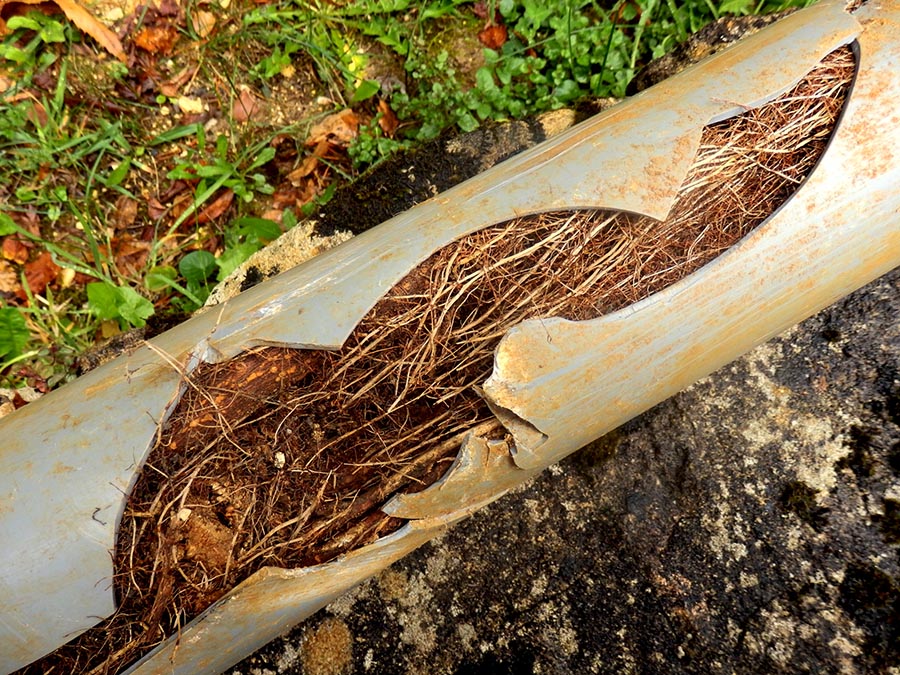
It is easy to underestimate a root tip. To the touch, it feels soft, fleshy, and harmless—hardly a match for an “armor-plated” liner. But this softness is deceptive. Biologically, a root tip is a powerful hydraulic drill. Since roots are genetically programmed to seek moisture, they don’t stop when they encounter a liner; they exploit.
Applying the Pressure: A growing root tip can exert hundreds of pounds of pressure per square inch (PSI). It hunts for microscopic imperfections—a micro-crack in HDPE or a scratch in EPDM.
Inserting the Wedge: Once the tip enters a vulnerability, it expands as it matures. The soft root becomes a woody wedge, slowly prying the material apart from the inside.
The Seam Threat
The biggest vulnerability isn’t the middle of the sheet; it’s the seam.
Taped Seams (EPDM): Roots are notorious for burrowing into the overlap of a taped seam. The adhesive eventually weakens, and the root slides between the layers, drinking from the pond while simultaneously peeling the seam open from the inside.
Welded Seams (RPE/HDPE): This is where heat welding shines. Because the two sheets are fused into a single piece of material, there is no flap for a root to exploit.
A Note From the Trenches: Beware “The Runner”
While most trees are opportunistic, some plants are aggressive predators. Running Bamboo and Cattails possess sharp, hardened rhizomes (underground runners) that are sharp enough to pierce 45-mil rubber. If you have these species near your pond, no flexible liner is safe without a dedicated physical root barrier (such as a concrete trench or a heavy HDPE deflection sheet) installed vertically between the plant and the pond.
The Real Armor (Geotextile Underlayment)
Underlayment is often where builders try to save money. Many view it as an optional accessory—a ‘comfort blanket’ for the liner—or a pro forma requirement to avoid voiding the warranty. But this reflects a fundamental misunderstanding of physics. A high-quality nonwoven geotextile isn’t meant to make anyone comfortable; its real purpose is to change how the liner interacts with the ground it’s installed in.
Point Load Dispersion
We established earlier that point loading (a sharp force on a single spot) is a liner’s true enemy. Fortunately, your nonwoven underlayment provides the same mode of protection as a bulletproof vest. Imagine if the underlayment were a layer of Kevlar shielding your skin, with the jagged rock replaced by a projectile:
Without Underlayment: When a jagged rock presses against the liner with 50 lbs of force, all that energy is concentrated on a pinhead-sized area. That’s a puncture waiting to happen.
With Underlayment: Geotextile fabric is thick and fibrous. When that same rock presses up, the fabric absorbs the sharp edge and distributes the 50 lbs of force over a much wider area (e.g., 3 square inches instead of a pinhead). The sharp spear (or bullet) becomes, in effect, a dull, blunt object, something that even a thin reinforced liner can easily withstand.
The Friction Barrier
Despite appearances, your pond’s structure is not static. As temperatures swing from winter to summer, your liner expands and contracts, shifting slightly against the subgrade.
The Grit: If your liner is sitting directly on soil or sand, the subgrade acts like sandpaper. Over years of thermal cycling, the liner abrades from the bottom up, eroding the material until it’s so thin a tiny tear or hole appears—and that’s where the failures start.
The Slip Layer: The geotextile layer provides a smooth “slip” between the liner and the earth (imagine a lady’s slip or the soft satin of a suit jacket). It allows the liner to shift and settle without grinding itself to death against the substrate.
A Note From the Trenches:
Old-school pond builders occasionally suggest using old carpet or layers of newspaper as cheap underlayment. Don’t do it. Exposed directly to the soil, these organic materials rot, and within a few years, they turn into a layer of slime, leaving your liner in direct contact with the rocks you were trying to hide. Always use a synthetic, nonwoven geotextile that will outlast the liner itself.

