

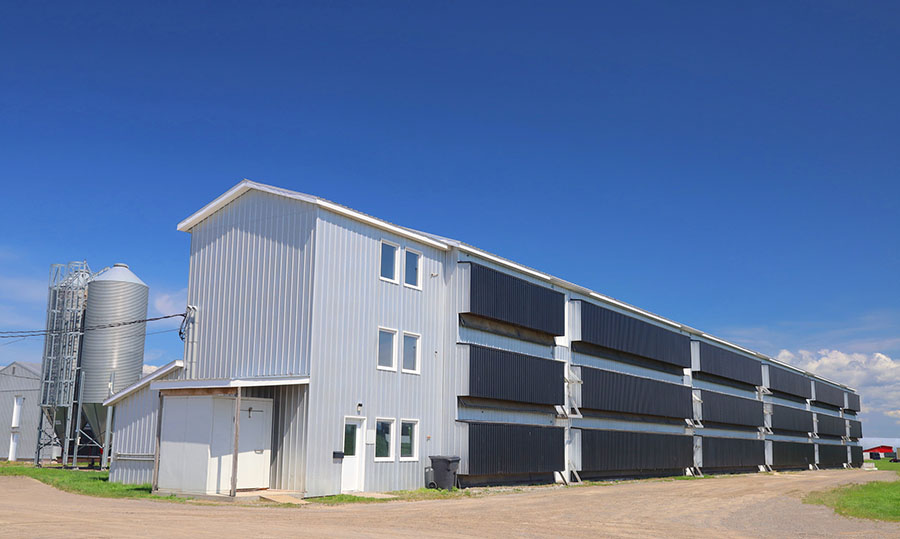
So, you’ve established yourself as a successful hobbyist, raising insects in your shed or garage. You have a few regular customers and a nice little side hustle. You’re making money, and you’re thinking, “If I can make $500 with 50 bins, I bet I can make $50,000 with 5,000 bins, right?”
Stop. Take a breath.
That simple assumption—that you can “do more of the same”—is exactly what keeps a side hustle from growing into a successful business.
Startup consultants call this phase the Valley of Death. It’s the dangerous gap between a profitable hobby farm and a profitable commercial facility. The difference here is that scaling a biological manufacturing plant isn’t linear—it’s exponential. The manual techniques that made you successful at the hobby level (hand-feeding, hand-sifting, misting bottles) are the exact things that will bankrupt you at the commercial level.
That’s a sobering idea! So before we get into the operational nitty-gritty, let’s talk about the math of scaling and why you need to shift your perspective from farmer to CEO.
The Math of Scaling: Avoiding the “Linear Trap”
In the hobby phase, labor is free. You don’t count the hours you spend sifting mealworms on a Saturday because you enjoy it. (You don’t pay yourself for it, either.)
But when you scale, labor becomes your biggest liability.
The Linear Trap
Want proof? Let’s do the math on the “More of the Same” strategy.
Current State
Let’s imagine that you have 50 bins. It takes just 2 minutes to feed and mist one bin. Total time: 100 minutes (1.6 hours). Easy. You can do that after work.
Future State
To nab a commercial contract, you scale operations to 2,000 bins. Total time: 4,000 minutes (66 hours).
And therein lies the problem: That’s 66 hours every day to feed and water your bins just one time. You still need to harvest, clean, pack, and—oh, yes—sleep!
In other words, if you try to scale using your current manual methods, you won’t even make it through the first day, much less make a profit. Worse, you can’t hire enough people to sift bugs by hand and still make money—the margins are too thin.
The Solution? Decoupling
To cross the Valley of Death, you have to decouple your revenue from your labor hours. This means developing systems where feeding 1,000 bins requires no more human effort than feeding 100.
In other words, this isn’t a hobby anymore. It’s time to stop “caring” for your bugs and start managing a production line.
The Three Choke Points
As you cross the Valley of Death (dun dun dunnnn!), three specific systems can choke your business. Let’s consider how to systematically upgrade each one.
The Labor Choke Point (Sifting)
Feeding is easy. Harvesting is hard. In a manual farm, separating insects from frass (manure) takes 50% of your total labor time. In a word, if you’re still shaking a sieve by hand, you’re a hobbyist. To pass through the “valley” into a sustainable business, it’s time to move to mechanical separation—trommels, shakers, and airflow systems capable of processing 100 lbs/hour.
The Climate Choke Point (HVAC)
In a garage, a decent space heater and a fan work fine. In a 2,000 sq. ft. warehouse, that setup would be a disaster. The air would stratify, leaving your top shelves to cook at 100°F while your bottom shelves remain chilly at 65°F. This would slow production, cause uneven growth rates, and make timing harvests a complex disaster.
We’ll talk about commercial air circulation and insulation envelopes in the next chapter.
The Input Choke Point (Feed Cost)
When you have 50 bins, buying 50lb bags of chicken feed from Tractor Supply is fine. When you have 2,000 bins, the cost of retail feed will eat your entire profit margin. Commercial farming requires sourcing bulk waste streams—spent brewer’s grains, pre-consumer food waste, or mill byproducts. This is where you stop being a customer at the feed store and start being a waste-management partner for local businesses.
The CEO Mindset
Our goal is to get you and your new commercial insect farm safely across the Valley of Death.
To get there, you have to be willing to make substantial changes. You might love hand-feeding your crickets. You might take pride in your DIY wooden bins. But if those things are preventing you from scaling, they have to go.
In the coming chapters, we’re going to look at industrial facility design, automated feeding systems, and the machinery that replaces your manual labor.
Put down that sifting screen and pick up your clipboard: It’s time to build a factory!
A Note from Your Partners at BTL Liners
Scaling is stressful. Your equipment shouldn’t be.
The “Valley of Death” is littered with hobbyists who failed because they tried to scale using temporary materials. While cheap tarps and hardware-store plastic might be priced comfortably for a hobbyist, those materials will inevitably tear, degrade, and harbor bacteria, spelling disaster in a commercial facility.
At BTL Liners, we specialize in industrial-grade RPE and reinforced films designed for the long haul. When you’re ready to build your permanent facility, give us a call. We can help you design a biosecure envelope that lasts for years, not months.

