

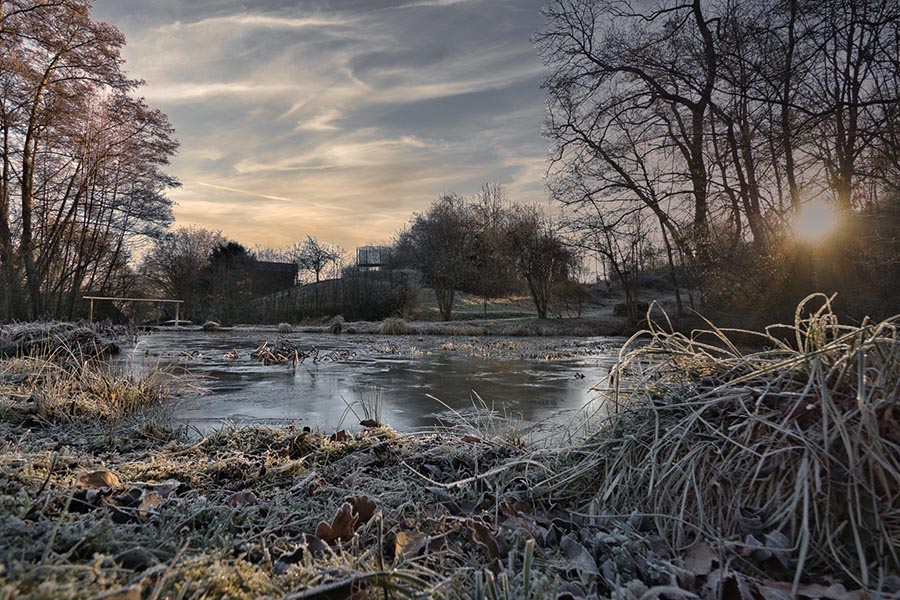
Successfully overwintering prize pond fish is a primary goal for any serious keeper in a cold climate, but it requires a significant shift in thinking. Once a pond ices over, it becomes a sealed environment with a unique set of rules governed by physics and biology. Failure to understand these rules is the most common reason pond keepers lose fish during the winter.
We’ll start with describing the scientific foundation for every decision you will make and cover the core principles that dictate survival beneath the ice:
- Why ponds freeze from the top down
- How water separates into layers based on temperature
- The importance of dissolved oxygen (DO) in a sealed pond and how gas exchange is managed.
- The dangers of anoxia (lack of oxygen) and the buildup of toxic gases.
With this solid foundation, you’ll be able to make confident choices in pond design, equipment, and winter management.
The Physics of Water: Why Ponds Freeze from the Top Down
The survival of your fish through the winter depends on a peculiar property of water. Unlike most substances we’re familiar with that grow steadily denser as they get colder, water reaches its maximum density at 39.2°F. This single fact dictates how a pond behaves when temperatures dip past freezing, and creates the conditions necessary for life to persist under ice.
Here’s how it works: As autumn air cools the pond's surface, the colder, denser water sinks. The water’s movement mixes the water column until the entire pond, from top to bottom, reaches a uniform of 39.2°F.
This is where the magic happens. As the surface water continues to cool below 39.2°F, it actually becomes progressively less dense. The lighter water remains at the surface instead of sinking and insulates the warmer, denser water below. When the surface temperature hits freezing, (32°F), ice begins to form. Because ice is significantly less dense than liquid water, it floats. This floating cap of ice forms an insulating lid over the pond and protects the stable, liquid water at the bottom where your fish will spend the winter. This protected zone is called the hypolimnion, and maintaining its integrity is the primary goal of winter pond management.
Understanding Thermal Stratification and Seasonal Turnover
Now that you understand how water density works, let’s look at how it organizes your pond during the year. In the summer, your pond isn’t one uniform body of water; it’s distinctly layered. This is called thermal stratification.
Thermal Stratification: It’s Got Layers, Like a Parfait!
- The Top Layer (Epilimnion): This is the warm, sunlit surface water. It gets plenty of oxygen from the air and from aquatic plants.
- The Middle Layer (Thermocline): Below the surface is a thin layer where the temperature drops rapidly. This acts as a barrier, preventing the top and bottom layers from mixing.
- The Bottom Layer (Hypolimnion): This is the cold, dark water at the bottom of the pond. It’s cut off from the sun and air, so oxygen levels are lower here. This is also where organic debris, like fish waste and dead leaves, accumulates and decomposes.
Since these layers remain stable throughout the summer, the critical event for winter preparation happens in the fall. As the air cools, the pond’s top layer also cools. When the temperature and density match the bottom layer, the stratification breaks down. At this point, a strong autumn wind can mix the entire pond from top to bottom, an event known as fall turnover. It’s a vital process that brings oxygen-depleted water up from the bottom to be re-oxygenated at the surface. Think of it as your pond taking a last deep breath before ice seals it off for the winter. Turnover ensures the entire water column is charged with the dissolved oxygen your fish will need to survive the coming months.
The Air under the Ice: Dissolved Oxygen (DO) and Gas Exchange
Your pond has taken its last deep breath during fall turnover and is now fully charged with oxygen. Once a layer of ice forms, the pond effectively holds its breath for the rest of the winter, as the water is cut off from its main supply of fresh oxygen.
In this case, we’re talking about Dissolved Oxygen, or DO. These are microscopic bubbles of oxygen suspended in the water that your fish breathe through their gills. In the summer, DO is constantly replenished by wind and wave action at the surface, through photosynthesis by aquatic plants, or possibly through mechanical aerators.
Winter conditions can severely limit these sources. The ice cap obviously prevents any wind from reaching the water. Furthermore, a layer of snow on top of the ice can block sunlight, shutting down any remaining photosynthesis from underwater plants, and some pond owners or managers may choose to turn off aerators during the winter. This means the DO your pond had after the fall turnover is all it has to last until the spring thaw.
But getting oxygen in is only half the story; letting out harmful gases is just as important. This two-way process is called gas exchange. Just like land animals, fish release carbon dioxide as they breathe. At the bottom of the pond, decomposing leaves and waste produce other toxic gases, like hydrogen sulfide. Without an opening in the ice, these gases are trapped and can build up to dangerous levels.
Therefore, the challenge of the under-ice atmosphere is twofold: conserving the limited oxygen supply while allowing toxic gases to escape.
The Dangers of Anoxia and Toxic Gas Buildup
When gas exchange fails in a pond sealed by ice, the result is a severe lack of dissolved oxygen, a dangerous condition called anoxia. Anoxia is the primary cause of “winterkill,” the term for fish dying under the ice. While fish slow their metabolism significantly in cold water, they still require a constant, minimum supply of oxygen to survive.
Anoxia is often paired with a second, equally dangerous problem: the buildup of toxic gases produced by decomposition in the oxygen-poor environment at the bottom of the pond.
Carbon Dioxide (CO₂)
All fish release CO₂ as they breathe. When this gas is trapped by ice, high concentrations can make it difficult for fish to absorb and use the remaining dissolved oxygen in the water.
Hydrogen Sulfide (H₂S)
This is the most acutely dangerous gas. You may be familiar with its signature “rotten egg” smell. It’s a byproduct of anaerobic bacteria (bacteria that thrive without oxygen) breaking down sludge and organic waste at the pond’s bottom. Hydrogen sulfide is highly toxic to fish, even at very low levels.
When anoxia and toxic gas buildup develop, they create a vicious cycle. Low oxygen allows the bacteria that produce hydrogen sulfide to flourish. As concentrations of hydrogen sulfide and carbon dioxide increase, they make it even harder for your fish to utilize what little oxygen is left. This downward spiral is the scenario every pond keeper must actively work to prevent. Understanding how these threats develop is the first step toward ensuring a healthy spring awakening for your fish.

