

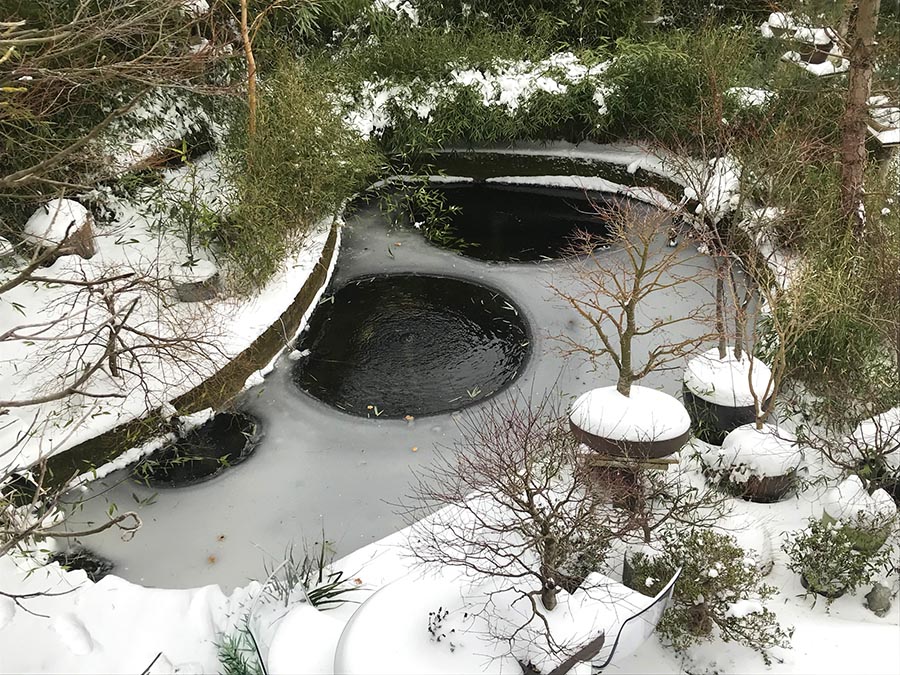
Now that we’ve covered the complete lifecycle of a winter pond, from science and design to the year-round calendar of care and the equipment that provides a critical safety net, we’re ready to explore topics that go “beyond the fundamentals.” We’ll cover the role of aquatic plants in winter ponds, then wrap up by touching on a few other interesting topics.
The Role of Aquatic Plants in the Winter Pond
When conditions are right in a winter pond, aquatic plants are a real asset, supplying oxygen and vital cover. When conditions are, well, wintry, they can trigger precisely the toxic conditions you’ve worked so hard to prevent. In the end, the key to winter survival is choosing the right types of plants and managing them correctly in the fall.
The Benefits: Oxygen and Cover
Hardy submerged plants (like Hornwort or Anacharis) are the most beneficial types of plants for a winter pond. On sunny days, even under a thin layer of clear ice, they continue to photosynthesize, producing small but valuable amounts of dissolved oxygen. The physical structure of these and other dormant plants also provides natural cover, which can help fish feel more secure when they’re moving slowly.
The Risks: Decomposition and Oxygen Drain
Decomposition is the primary risk. Any plant matter that dies and decays in the pond consumes oxygen and releases harmful gases that can’t easily escape when the water is covered by a sheet of ice. The problem is compounded at night, on dark days, and under snow cover, when they can’t produce oxygen through photosynthesis but continue to respire and consume oxygen, just like your fish.
In the worst-case (and more common) scenario, light is completely blocked by snow, short days, and dense clouds, shutting down photosynthesis entirely. In this “blackout” scenario, a large mass of submerged plants switches from being a potential asset to a significant liability. They become a major drain on the pond’s finite oxygen reserves, competing directly with your fish and accelerating the depletion of oxygen.
Controlling the Variables
Your goal is to maximize the benefits while minimizing the risks, which means implementing your strategy in the fall.
Hardy Submerged Plants (Keep)
A moderate, managed amount of “oxygenators” like Hornwort (Ceratophyllum) and certain species of Anacharis (Elodea)is beneficial.
Hardy Marginal/Bog Plants (Trim)
For plants like cattails or irises, their root systems are fine. However, you must aggressively trim all dead or dying leaves and stems in the fall to prevent this material from falling into the pond and rotting.
Floating Plants (Remove)
Tropical floaters like Water Hyacinth and Water Lettuce will not survive a hard freeze. They must be removed entirely before the first frost. If left in the pond, they will die and turn into a large mass of sludge, fueling a toxic disaster over the winter.
The Verdict: Balancing Your Risks
The realistic impact of submerged plants is that they are a gamble that depends on your local winter weather. If you typically experience long periods of sunny, snow-free cold, it is a net benefit. If you have a typical northern winter with heavy, persistent snow cover, it can become a dangerous oxygen drain.
This is precisely why our management advice is to keep only a moderate amount of hardy submerged plants. You want enough to gain the potential benefit during sunny periods, but not so many that they become a major oxygen liability during the inevitable dark, snowy weeks.
The Indoor Alternative: Worry-Free but Work-Heavy
If the thought of your prize koi spending months under a sheet of ice keeps you up at night, there’s another path: bringing them inside for a winter vacation. This is the go-to strategy for owners of very valuable fish or anyone with a pond that’s too shallow to be a safe bet against a deep freeze. It’s a tempting failsafe—you assume total control in exchange for a 100% guarantee against winter-related disasters.
So, seriously, what’s the catch? Well, to start with, it’s a serious project that requires a lot more than just sticking a few large fish in a spare aquarium. A successful indoor setup requires a dedicated, large-volume stock tank, a robust filtration system, and its own unique care routine. Honestly, the complete “how-to” of indoor overwintering is a book in itself. For this guide, we’re focused on mastering the art of the in-pond winter, but it’s good to know this option exists as the ultimate safety net.
A Note on Large Ponds and Lakes
While the fundamental science of overwintering is universal, the practical management of large ponds and small lakes is a different discipline from backyard pond keeping. As the volume of water grows into the tens of thousands of gallons and beyond, tools and techniques must be scaled up significantly.
Larger bodies of water require distinctly different strategies, such as a winter drawdown (intentionally lowering the water level to reduce ice pressure and manage shoreline weeds) and the use of much larger, more complex aeration systems. Planning these systems requires a deep understanding of the specific hydrology and ecology of the water body.
A full exploration of these advanced, large-scale strategies is a complex topic that warrants its own dedicated guide.
Emerging Technologies in Pond Monitoring
It seems like everything in the world has a “smart” version now, from your doorbell to your dog’s water bowl. So it should come as no surprise that you can now connect your fish pond to your Wi-Fi.
While the idea of a pond thermometer needing its own app might seem like overkill, let’s be fair—the mercury-filled thermometers of our childhood have been replaced by instant-read digital versions for a reason. The new generation of smart pond devices offers the same evolution: they replace seasonal guesswork with hard data, which can provide incredible peace of mind.
Smart Water Monitors: Your Pond’s Dashboard
Instead of trudging out in the snow to dip a thermometer, these Wi-Fi sensors give your pond its very own dashboard on your phone. They constantly track the water temperature, so you’ll know exactly when to stop feeding without playing the “is it consistently below 50°F yet?” guessing game. Some advanced models can even monitor pH and send you a “panic alert” if your water chemistry starts to go sideways.
Submersible Cameras: The Anxiety Killer
For the ultimate “are they okay down there?” worrywart, a submersible Wi-Fi camera is the answer. Just drop the waterproof camera through your air hole and get a live video feed of your fish resting peacefully at the bottom. It’s the perfect way to soothe your winter anxiety with a quick, reassuring glance at your phone.
Smart Plugs: Remote Reassurance
Even the humble electrical outlet has gotten an upgrade. Plug your aerator or de-icer into a Wi-Fi-enabled smart plug, and your phone’s app can now tell you if the power is on and the equipment is running. It’s a simple trick that can save you a lot of anxiety after a winter storm blows through.
Are any of these gadgets essential? No. Your pond can survive without being connected to the cloud. But they are powerful tools for turning your winter anxiety into informed confidence, and that peace of mind can be priceless.
And Finally: Your Path to a Successful Spring
Overwintering a fish pond can seem like a daunting task: a season of uncertainty spent wondering what’s happening beneath the ice. Our goal with this guide has been to replace that uncertainty with knowledge and transform the winter vigil from a passive act of hope into a confidence-building roadmap to preparation and management.
Design Dictates Destiny
The depth you dig, the shape you form, the location you choose, and the quality of the liner you install as your foundation all come together to create an environment that is either inherently resilient or inherently risky.
Fall is the Decisive Season
With a solid design in place, the focus shifts to preparation. Ultimately, winter survival is an oxygen game, and fall is the decisive season. Every action you take in autumn—from aggressively removing debris to making the final, critical decision to stop feeding—is about filling the tank with as much life-sustaining oxygen as possible and removing every potential threat to it.
Management and Equipment Involve Critical Trade-offs
Finally, your active management must be thoughtful, deliberate, and scaled to your specific system. At the same time, your equipment choices involve critical trade-offs. The right aeration strategy, the decision to run your pump, and the tools you use to monitor the pond are not one-size-fits-all. They are, however, deliberate choices you can make based on a clear understanding of your pond’s design and your goals as a keeper.

