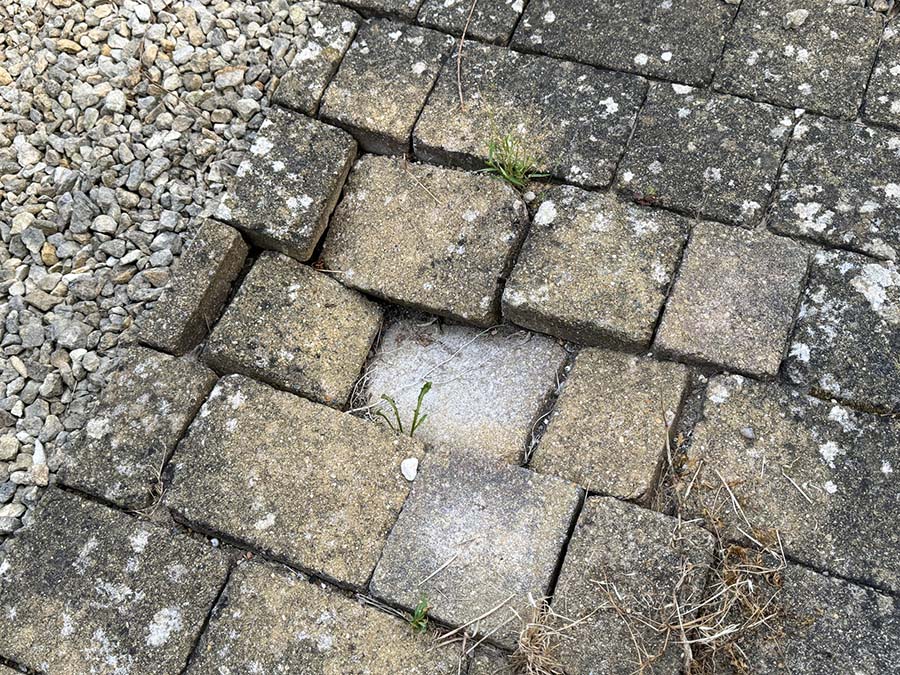
Let’s jump right into one of the most expensive problems in the hardscaping business: the callback.
Maybe you’ve been there—you build a gorgeous paver patio, every line is perfect, the client is thrilled, and you walk away with a fat check. Then, a year later—maybe after a wet spring—you get the angry call. The patio is a mess. It’s got low spots that hold water, pavers are rocking, and the whole thing has settled unevenly. It’s the typical Sunken Patio horror story we referenced in Chapter 1, and now you’re on the hook to rip it all out and fix it for free.
Hey - it’s a disappointment, but maybe this will soften the blow: that failure wasn’t your workmanship, but a failure of separation. The ground underneath the patio did precisely what it was always going to do: the wet clay subgrade and your aggregate base mixed, turning your foundation into an unstable, mucky mess. Still, it could have been averted, and that’s why we’re here.
Here’s your technical guide to preventing that from ever happening: use the right woven geotextile to guarantee your hardscapes will last.
That Sinking Feeling: Why Patios Fail
To prevent failures, you need to understand the mechanics. A paver patio or walkway is what professionals call a flexible pavement system. The pavers themselves have no structural strength; they’re just blocks. All the strength comes from the interlocking of the pavers and, more importantly, the stability of the aggregate base underneath.
The components are simple, but let’s spell them out. You have:
- The pavers
- A thin layer of bedding sand
- A thick, compacted aggregate base (your crushed stone)
- The native soil subgrade (often the problem child: clay)
This system works well only when these layers stay separate. The aggregate base is strong only when it’s clean, angular, and well-compacted, so the stones lock together.
The Stealthy Enemy: Water and Migration
Here’s the failure in slow motion: water from a heavy rain soaks through the paver joints and floods the aggregate base. Because it hits the less permeable clay subgrade, it can’t drain away quickly, so the clay gets wet and turns to a mucky, soft mess.
Now, two things happen at once, and they’re both bad:
Sinking
The weight of the patio and the people walking on it pushes the sharp, angular aggregate down into the soft, wet clay, like pressing marbles into a bowl of thick pudding (who does that, anyway?).
Pumping
At the same time, the pressure of that weight forces the fine clay particles up into the aggregate base.
Now your clean, interlocking stone base is contaminated with fine-grained soil. It doesn’t lock together, it can’t drain properly, and it loses its load-bearing capacity. As the foundation turns to mush, your pavers start to sink and shift. It’s that simple, and it’s a preventable failure.
Guaranteeing a Stable Foundation
So here’s where a lot of crews get it wrong: a simple nonwoven felt fabric can’t solve this problem. It might provide separation for a little while, but it’s a filter, not a stabilizer. It will stretch, deform, and ultimately fail under the load.
The actual solution—the one that’s callback-proof—is to install a material that provides both separation and stabilization in one tool. That tool is the slit-film woven geotextile. You place a single layer directly on your prepared soil subgrade before laying your aggregate base. This one step completely neutralizes the problem by performing both critical engineering functions simultaneously.
It Provides True Separation
First, the woven fabric establishes an impenetrable barrier between your two problem layers: the mucky subgrade and the clean aggregate.
- The pumping action is stopped cold. Fine clay particles cannot migrate up into your stone base, so your aggregate stays clean, angular, and able to interlock properly.
- The sinking action is also stopped. The fabric distributes the load of the aggregate, preventing sharp stones from being pushed into the soft soil.
It Actively Stabilizes the Subgrade
This is the part many contractors miss. A woven geotextile doesn’t just sit there; it actively reinforces the entire system. We saw this in Chapter 2, when we compared the specs for woven and nonwoven fabrics. Woven geotextile fabrics, as a class, have high tensile strength but very low stretch.
So when you place a slit-film woven geotextile over soft, mucky clay and then put a load on top (like a paver or a person), the fabric immediately goes into tension. This distributes that focused load over a much wider area of the subgrade.
It’s the same principle as the rebar in concrete, or even snowshoes on deep snow. It prevents the load from punching through the weak subgrade and dramatically increases your foundation’s load-bearing capacity.
It’s this combination of separation and stabilization that gives you a rock-solid, callback-proof foundation. It keeps your layers clean and leverages the geotextile’s strength to strengthen the entire system.