If you walk away with only one thing from this entire guide, let it be this: Woven and nonwoven fabrics are two completely different tools.
This is, without a doubt, the single most common and costly mistake we see in the field. A contractor sees “fabric” on the spec sheet, grabs the cheapest roll of whatever is handy, and installs it under a paver patio. A year later, the patio is sinking, and they’re eating the cost of a full redo.
The problem? They used a nonwoven filter fabric when the job required a stabilizer—a woven fabric. That’s a guaranteed failure and entirely preventable.
Let’s take a moment to investigate the why behind your two main geotextile tools. You’ll get the engineering details—how they’re made, what their spec sheets actually mean (from tensile strength to flow rate), and how those properties make a fabric the only choice for a particular job. This distinction is what separates a professional, callback-proof installation from an embarrassing (and costly!) failure.
The Stabilizer: A Steady Look at Woven Geotextiles
Woven geotextiles are your heavy-lifters. This is the tool you pull from the truck when you need brute strength and stability. In fact, you can think of it less like a simple 'fabric' and more like a sheet of industrial-grade, ripstop sheathing for the ground.
How They’re Made (And Why That’s Relevant)
Clearly, they’re woven— that’s in the name! But their specific properties come from how they’re woven. Let’s not confuse these with that fuzzy, felt-like material sold as landscape fabric: woven geotextiles are high-strength, engineered textiles, and the specific type you’ll need for these jobs is a slit-film woven geotextile.
For slit-film wovens, the manufacturing process starts with a tough polymer, usually polypropylene, extruded into a continuous sheet of plastic. Next, that sheet is precisely cut, or slit, into strong, flat tapes or yarns which are woven together on massive industrial looms in a tight, grid-like pattern.
This slit-film construction is the secret to its performance. The interlaced grid of flat tapes gives the fabric immense strength and will stop a tear in its tracks. But the weave also controls its permeability. By precisely adjusting the tightness of the weave, the manufacturer can control the size of the pores, or openings, between the tapes. In other words, slit-film wovens are built for toughness but can still permit a (low) controlled flow rate. They’re definitely not a good choice for the high-volume drainage you’d want in a filter.
Key Engineering Properties
A spec sheet for a woven fabric will include a few key metrics. Here’s what they actually mean for your job site:
High Tensile Strength
This is the most important spec. The woven grid gives this fabric incredible strength when pulled. It has minimal stretch (low elongation). Low stretch is what allows it to take the load of a dump truck or a paver compactor and spread that force across the subgrade without leaving ruts or indentations.
Superior Puncture and Tear Resistance
A woven fabric's real advantage is its superior tear resistance. If a sharp rock somehow manages to make a hole, the woven tapes act as a ripstop, isolating the damage and preventing it from zippering into a massive failure.
Controlled Permeability (a Critical Distinction)
This is a point that can sink a lot of projects. A slit-film woven fabric is not impermeable, and that’s a good thing. Water can seep through it, just very slowly. The tight weave of flat tapes creates a complex path that lets water pass, but not freely. This is precisely what makes it the perfect tool for separation and stabilization, but a terrible choice for a French drain, where its function depends on high flow.
More importantly, this controlled permeability makes it superior to an impermeable liner (such as an RPE or HDPE pond liner) for any hardscape job. If you use a truly impermeable sheet under a patio or driveway, you’re essentially creating a bathtub. Rainwater gets trapped in your aggregate base and turns it into a soupy, unstable mess. In cold climates, this trapped water will freeze and expand, causing massive frost heave that can completely destroy the hardscape.
A slit-film woven geotextile avoids this entirely. It’s strong enough to separate and stabilize, but still permeable enough to let water drain through and keep the system from saturating and failing.
The Bottom Line: Its Job on Your Site
Based on these properties, the woven geotextile is best suited to two primary jobs:
Separation
Slit film woven is the perfect barrier between your expensive, clean aggregate base and the mucky clay subgrade below. It keeps your stone from being pushed down and the mud from pumping up.
Stabilization
A woven geotextile is the rebar for your gravel driveway or paver base. It takes focused traffic load—whether vehicles or many feet—and spreads it out, preventing the subgrade from deforming and causing ruts and sinking that spell disaster for your project.
In a word, woven geotextiles are your foundation saver. This fabric is ideal for any job that requires building a stable hardscape on questionable soil.
The Filter: A Quick Look at Nonwoven Geotextiles
Now for the other main tool in your truck: the nonwoven geotextile. This is your specialist for drainage and filtration. It looks and feels completely different from a woven—it’s typically a fuzzy, felt-like fabric.
How It’s Made (And Why It’s Different)
There’s no weaving involved. Nonwovens are made from a random web of short and long synthetic fibers that are bonded together, either by needle-punching (which mechanically tangles the fibers) or with heat or chemicals. This matted, random structure is the key to its properties. It really does resemble felt or very dense fiber insulation.
Key Engineering Properties
High Permeability (High Flow Rate)
Permeability is a nonwoven’s #1 job. That random, felt-like structure creates millions of tiny, complex pathways for water to pass through quickly and easily. It’s designed to have a high flow rate.
Excellent Filtration
While nonwovens let water flow freely, those same complex pathways are fantastic at trapping fine soil particles (silt and sand) and preventing them from passing through.
Lower Tensile Strength
This is the trade-off. Because it has no reinforcing grid, a nonwoven has much lower tensile strength than a woven fabric. It’s stretchy and can be torn or punctured more easily under high-load applications.
The Bottom Line: Its Job on Your Site
Based on these properties, the nonwoven geotextile has just one primary, critical job: filtration.
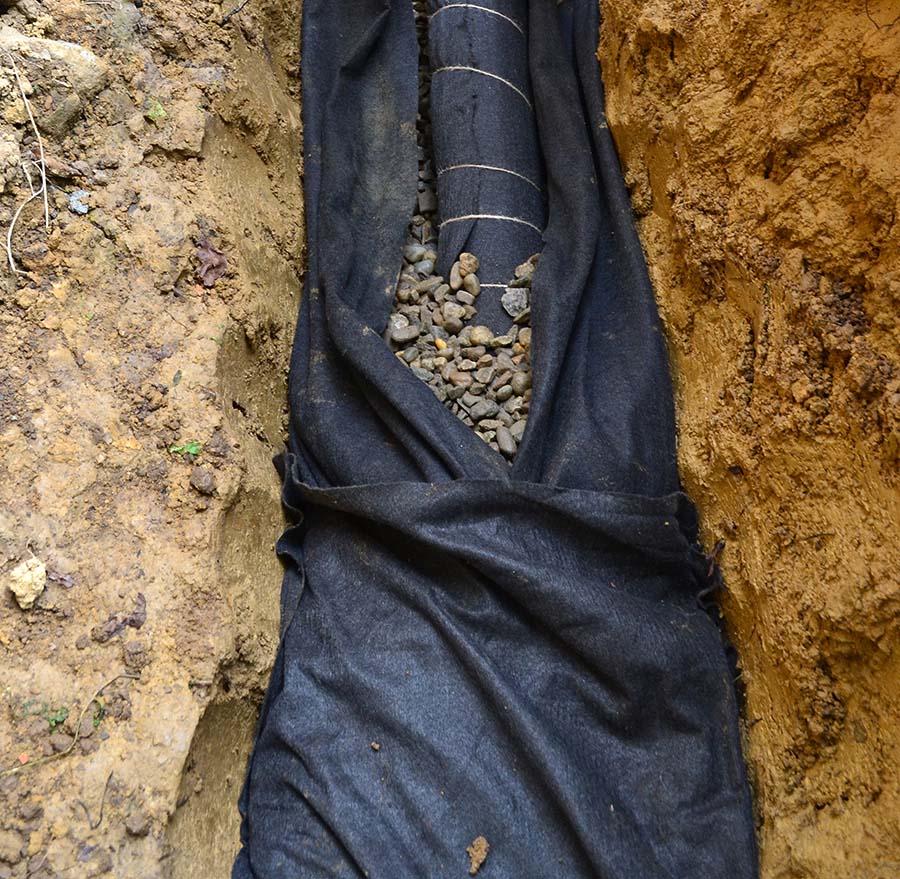
In fact, this is the only fabric you should consider for a French drain, behind a retaining wall, or as a filter for any drainage system. It keeps your pipes and drainage stone from clogging with silt, so the system will run clean for decades.
Remember: Nonwovens aren’t stabilization fabrics. If you put one under a paver patio or driveway, it will stretch, deform under the load, and your hardscape will fail. It’s the right tool for drainage, the wrong tool for stabilization.